

Going back at least to Swift and his dream of replacing humans with horses, misanthropy in the arts is generally powered by moral disgust. That’s certainly the case for Bugonia, which may be Yorgos Lanthimos’ most straightforward missive from the land of the Houyhnhnms—even if the equines in this case buzz onscreen in the form of Apidae.
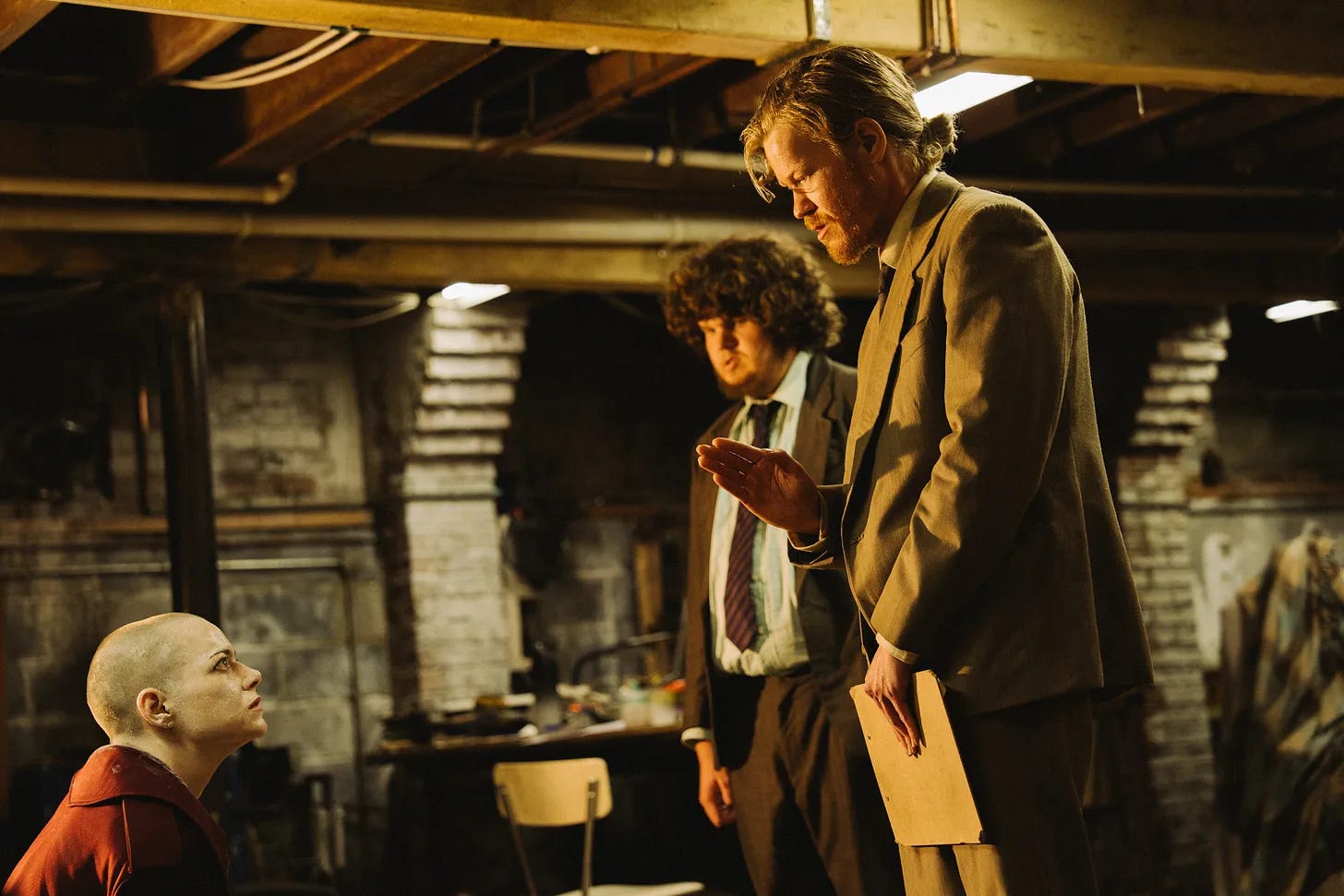
The main bees we’re introduced to are from the hive of Teddy Gatz (a disturbingly cadaverous Jesse Plemons.) Teddy is a conspiracy theorist who believes that the ongoing planetary bee extinction is part of a sweeping plot to destroy humanity promulgated by alien Andromedans who have infiltrated the earth. To thwart their evil scheme, Teddy kidnaps Michelle Fuller (Emma Stone), the CEO of Auxolith. Teddy believes Michelle is an alien who can take him to meet the Andromedan emperor during the lunar eclipse four days away. In the meantime, he keeps her in his basement for questioning and sporadic terrorizing/torture.
—
Everything Is Horrible is entirely reader funded. Please consider becoming a paid subscriber; it’s $50/year, $5/month.
—
Teddy is a jittery, somewhat sympathetic, and all the more vicious for that, portrait of a populist anti globalist—with, yes, the antisemitic connotations attached. Michelle, for her part, is a tightly wound, somewhat sympathetic, and all the more vicious for that, portrait of a self-absorbed and contemptuous corporate elite.
Lanthimos pits these two contemporary archetypes against one another, and then gleefully sets about having them one-up each other in awfulness. Teddy subjects Michelle to horrific electroshock treatments while blithering away about alien invasions. Michelle, when she gets the upper hand, spews acidic neoliberal hate, shouting at Teddy that he’ll always be a loser and she’s a winner and that’s why she wins.
Michelle’s under considerable pressure, so you could perhaps forgive her. But it turns out that Teddy’s under considerable pressure too; his mother was in an experimental trial for opiod addiction sponsored by Michelle’s company, and it put her in a coma. So maybe he’s the one who should be forgiven for his confused revenge—except, over the course of the film, it becomes clear that Michelle is not the first person he’s tortured in the name of his bizarre paranoia. His endless nattering, interrupted by explosions of violence, is one version of a bleak, banal evil. Another is Michelle’s bland, assurances that the corporation will change—by allowing people to leave work at a reasonable time, by providing adequate benefits to those harmed in its clinical trials—assurances which become less and less credible the more they’re repeated.
The only alternative to the howling void that is Teddy or the icy abyss that is Michelle is Don (Aldan Deblis), Teddy’s cousin, who appears to be autistic and/or mentally impaired. Don cares about Teddy and wants to help him; he’s also disturbed by Teddy’s brutality towards Michelle, and tries to talk him down, or in extremis even reaches over and pulls out the plug to stop the torture.
Don’ too easily manipulated and abused himself to function as much of a moral center though; Teddy convinces him to chemically castrate himself, and Michelle’s discussions with him have even worse outcomes. His moral compass doesn’t lead to moral outcomes. It just makes him vulnerable.
Humans aren’t just evil; the final twist of the knife is that they’re cringe. Teddy and Michelle’s conversations, in which he insists she’s an alien and she, with an alien lack of affect, insists she’s not, are hard to watch not because they’re suspenseful, but because they’re embarrassing. The bombastic soundtrack, which breaks into weird John Williams-esque fanfares at inopportune moments, deliberately mocks the film’ s own intergalactic drama.
Teddy’s cruelties are painful to watch in part because they’re so much smaller than he imagines them to be; Michelle’s petty hypocrisies (her peevish hypocritical filming of a pro “diversity” message) are more hypocritical for being so petty. No wonder, staring at each other across a couple of plates of unappetizing spaghetti, the only thing that Michelle and Teddy can agree on is that bees are better than we are. Even Lanthimos’ own failings in this context seem to become thematic; the film’s dicey use of antisemitic tropes and dicier ableist stereotypes just reemphasize that you can’t even trust the misanthropes, and that this whole human thing was maybe a mistake.
Some spoilers follow if you care about that sort of thing.
And so, since we’re a mistake, Bogonia gets rid of us. In the last twist of the film, it turns out that Michelle is an alien after all, and she and the Andromedans—whose language is like the buzzing of bees, and who dress in bulbous vaguely bee-like costumes— decide humans have had long enough. The movie closes with a series of painterly set pieces from the final extinction; dead bodies sprawled out at the beach, dead bodies sprawled out in a boardroom, dead bodies sprawled out in a doll factory among the dolls. The only living things left are a dog here, a cat there…and of course, the bees in Teddy’s apiary, buzzing oblivious and industrious, ready to continue to pollinate in a world without pesticides and with all the habitat in the world spread out before them.
The ambivalently lugubrious conclusion (with Marlene Dietrich’s “Where Have All the Flowers Gone” playing in the background) is a vision of utopia in part; Lanthimos, like Swift before him, dreams of never having to see a human again. But it’s not much of an escape when the Andromedans are still flying around out there, looking much like us and committing genocide much like us, even if they do it in bee drag.
For all its snark and absurdity and despair, Lanthimos’ message, like those of misanthropes before him, is uncomfortable not because it’s callous, but because it’s uncomfortably sincere. That message being that there aren’t aliens to destroy or save us. The fate of the bees, and of the human beings, is in the hands of the human beings—for better or, as may well be the case, for worse.
i've never heard of this film and likely will never see it, but, man, that's a hella good analysis and commentary, Noah. well done!
This was probably my favorite movie this year. I enjoyed your review. Happy holidays, that's all I got