

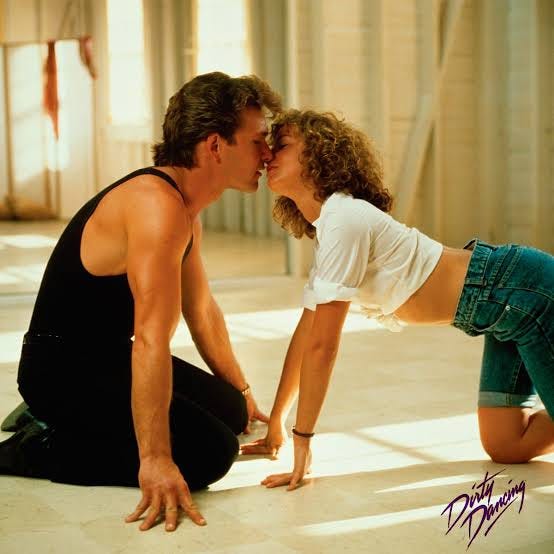
Dirty Dancing (1987) opens to the classic Ronettes track, “Be My Baby.” It’s sung by Ronnie Spector—who was Black—and produced by Phil Spector, Ronnie’s brutally abusive Jewish husband. The song is a metaphor and a soundtrack for the film itself, embodying the exhilaration and hope of cross-cultural and interracial collaboration and the queasy, potentially exploitive and unequal aspects of those collaborations.
—
Everything Is Horrible relies on your donations. If you value my writing, please consider becoming a paid subscriber.
—
The film is most famous for the exhilaration and hope—which it puts across with sweeping, winning verve. The plot (as you almost certainly know) follows Frances, aka “Baby” Houseman (Jennifer Grey) as she and her well-to-do family vacation at the Kellerman’s, a Catskills resort. There she becomes friendly with some of the staff, and discovers that one of the dance instructors, Penny (Cynthia Rhodes) is pregnant. To help Penny get an abortion, Baby borrows money from her father and agrees to take her place at a dancing gig with partner Johnny Castle (Patrick Swayze). Soon she and Johnny fall in love, to the horror of her nice guy doctor father Jake (Jerry Orbach.)
The film is generally presented as a story about upstairs/downstairs class barriers and prejudice. Baby’s father wants her to marry a doctor or lawyer; her dreams of joining the Peace Corps are acceptable as a prelude, but he balks at her actually marrying a non-college-educated working-class guy. Baby is attracted to the sweaty, hip-shimmying realness of the lower decks, but she is also (and this is what elevated the film above John Hughes’ contemporaneous efforts) genuinely outraged at injustice, and courageous in standing up to it. She is determined to help Penny, and when Johnny is falsely accused of stealing, she admits to her father that she was in his room rather than letting him take the fall.
In return for her decision to apply her father’s ethics more thoroughly than he would himself, Baby gets, not just Johnny, but the chance to join him on the dance floor. “Nobody puts Baby in a corner,” he insists, pulling her on stage; her reward for treating others as human is broader friendship and a broader, more brilliant sense of her own humanity.
Baby confronts her father directly about his class prejudice. But she doesn’t mention the other big-as-the-nose-on-her-face (or on mine) issue. The Hellerman’s are Jewish, as is the resort. This is not exactly a hidden truth—Sandy Koufax, rabbis, and Yiddish are all mentioned in passing. But the relevance to the central romance is tip-toed around. The resort-owner says that he hires waitstaff from Harvard and Yale to set up patrons’ daughters with acceptable romantic partners; he says that the entertainment staff, like Johnny, are to keep their hands off the same. But this again is framed as class, even though the issue is clearly also that the entertainment staff are not Jewish.
The class taboo is open; the Jewish/gentile taboo is half hidden. But racial taboos are more carefully erased.
There are a couple of Black dancers in the ensemble and the leader of the resort band is played by legendary tap dancer Honi Coles. But the main Black presence in the film (as in many films of the period, from The Big Chill to Beetlejuice) is on the soundtrack. Hits by the Drifters, Otis Redding, Solomon Burke, Merry Clayton, Maurice Williams, The Contours, and others provide the pelvis-grinding throb for dance numbers and emotional highs. In one telling scene, Johnny and Baby lip sync the flirtatious “Love Is Strange” by Mickey and Sylvia, a Black duo. In the long tradition of American pop culture, white people channel and appropriate Black style, Black music, and Black voices to associate themselves with love, passion, sex, and authenticity.
In the long tradition of American pop culture too, Black culture is welcome, but Black people less so. Johnny’s cool, his sexiness, and his outcast status are all signaled through his connection to Black music, Black dance, and (over on the side of the screen) Black people. But while class differences can be very legible, and ethnic/religious ones mildly so, the film in 1987 was absolutely not going to have Baby date a Black man. She tearfully and righteously tells her father that his class-based prejudices violate his own universal liberal platitudes. But neither she, nor the film is willing to extend those universal platitudes to the people whose music everyone is dancing to.
The point here isn’t that you shouldn’t like Dirty Dancing; I like Dirty Dancing quite a bit. But I think it’s a telling summary of where Hollywood liberal humanism was and was not willing to go in the 1980s, and to some extent still. It’s a political shibboleth that “culture war issues”—Black rights, LGBT rights, women’s rights—are a “distraction” from the class issues that really divide us. But it’s hard to miss the fact that in the 80s, Hollywood had no problem with forthright denunciation of class prejudice, tiptoed around ethnic difference, and studiously erased race and queerness. (Is Baby’s admiration of Penny just wanting to be her? Is there no element of wanting to be with her?)
In fact, in Dirty Dancing, it’s fair to say that class serves as a distraction from what the movie is saying about Jewishness, and that Jewishness serves as a distraction from what the movie is (trying not to be) saying about race. The film is dedicated to denying the extent to which, in the US, as Stuart Hall says, “race is the modality in which class is lived.” Johnny’s lower-class status is signaled through the “dirty”—that is to say, Black—music he dances to, but he can’t actually be Black, or the film would actually be defying social norms. “Be My Baby” in that context, means both that love triumphs over all and that, sometimes, unfortunately, it does not.
A thing I love about this movie is that Gentile viewers might never pick up on the Jewishness at the film’s core, while for Jewish audiences this film is more Jewish than Yentl