

This post grew out of a brief conversation with political scientist Julia Azari on bluesky, which I can’t find now. But I wanted to credit her. You should subscribe to her excellent group newsletter!
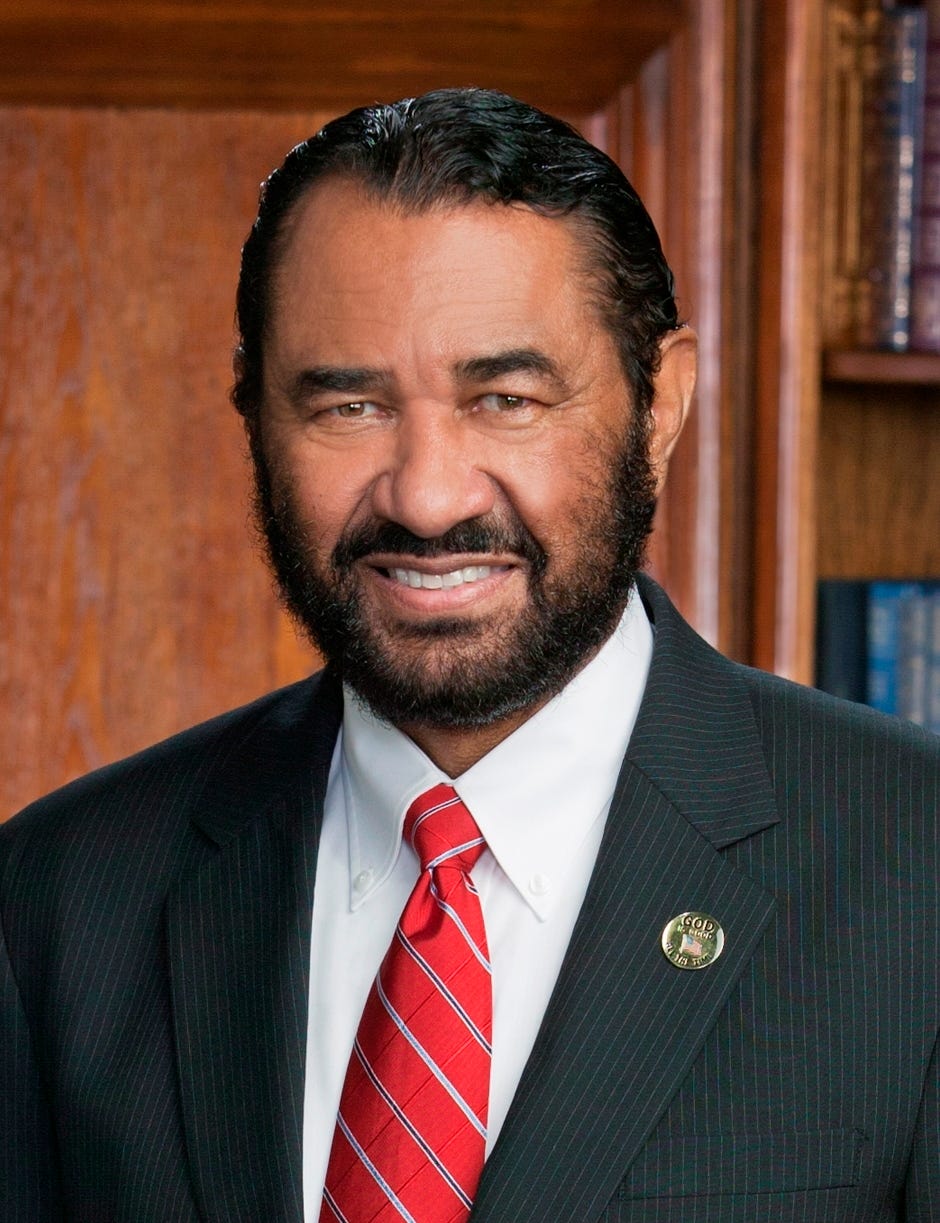
Last week, Democratic Representative Al Green once again introduced articles of impeachment, this time based on Trump’s social media post in which he threatened “Democratic lawmakers in Congress with execution. Once again the articles were voted down—though this time by a narrower margin. While more Democrats voted for the articles, and while leadership voted present instead of actively opposing the vote, though, a lot of Democratic lawmakers were still upset about being pushed to take a stand. “I hate it,” one anonymous Democrat told Axios. “This isn’t a team effort,” said another.
It’s not entirely clear why some Democrats are so dead set against impeachment. Hakeem Jeffries claimed there needs to be a “comprehensive investigative process” which seems pretty transparently silly when the president is publicly calling for the murder of opposition members on social media and issuing threats to unconstitutionally withhold funds from states if they defy him and generally just attacking and shredding the Constitution every day in the most public manner possible. Axios claims that reluctant Ds have some sort of principled stance against “the increasingly caustic use of impeachment,” which also sounds more like an excuse than a reason. Democrats have been pretty vocal about saying that Trump is a threat to the Constitution, and if he’s a threat to the Constitution, impeachment is the remedy. I have trouble believing Democrats don’t know that.
—
Everything Is Horrible is entirely reader funded. If you value my writing, consider becoming a paid subscriber. It’s $50/yr, $5/month.
—
Some commenters on social media have talked darkly about donors or corporate interests opposing impeachment, but I’m skeptical. Given that impeachment is very unlikely to succeed at this juncture with Republicans in control of Congress, it’s hard to imagine that corporations or donors would have strong feelings one way or the other. Ds vote yes, Ds vote no—it’s not going to affect anyone’s bottom line.
I think that the reason some Democrats are afraid of impeachment is that they think impeachment will annoy or alienate not donors, but voters. Many Democrats, especially centrist Democrats, are convinced that voters hate open partisanship and inside-the-beltway conflict, and they are terrified that if they too enthusiastically oppose Trump, or do so without procedural deliberation or caveats, they will lose voters and lose elections.
The base wants Democrats to fight. But Democrats worry that the broader electorate wants them to focus on nonpartisan kitchen table affordability issues. Democrats worry that fighting fascism will lose them elections—and for electoral politicians, winning elections tends to be the most important thing.
Winning vs. fascism vs. winning vs. fighting fascism
For partisans who follow politics closely, it seems obvious that if you’re in opposition you should just attack Trump and attack him again. He’s very unpopular—he just hit a low of 36% in the AP poll. And Republicans are getting crushed in off-year elections, where Ds are overperforming by an average of 13 points. He’s on the floor; kick that motherfucker.
The problem is that while voters hate Trump’s economy, most of them are not necessarily hyper engaged partisans, and they don’t always want partisan displays of kicking that motherfucker. G. Elliott Morris, in a much-admired poll earlier this year, asked voters open-ended questions about ideology. 26% preferred left policies and 26% preferred right policies. But around 38%—a plurality—“want a party that improves their general standard of living, and don’t use ideological language at all when describing what their ideal political party would stand for.” Morris said that in many cases, when asked about what kind of party they wanted, people said things like, “‘The American dream,’ ‘Work for the people,’ and ‘Affordability.’”
Democrats are often accused of not trying to address these kitchen table nonpartisans. But I think that’s confused. Republicans often don’t bother pitching to these voters, because they have a lot of advantages—vote suppression, Senate maps, voter distribution—which allows them to win elections with minority support. Democrats, though, are very aware that they have to work twice as hard to win narrow victories, and they are obsessed with trying to convince these nonpartisan voters that they are on their side.
Appealing to nonpartisan kitchen tableness was, in fact, a huge part of Biden’s domestic agenda. Biden passed an absolutely massive Covid relief plan; he approved billions in student loan forgiveness; he tried to raise the minimum wage; he made big investments in manufacturing; he tried to slash child poverty permanently; he embraced labor in an effort to raise wages and worker well-being; and on and on. Some of these efforts worked, some were partially or wholly blocked by Republicans (with the help of that fucker Manchin).
Biden couldn’t prevent the inflation caused by Covid dislocations—though he handled it about as well as any world leader. But it’s very clear that Biden wanted to raise the standard of living of working people and the middle-class. This was the basis of his re-election bid.
Trying to appeal to American Dream voters meant trying to cut costs and build prosperity. It also meant deliberately avoiding anything domestically that wasn’t doing those things. So Biden appointed bipartisan institutionalist goober Merrick Garland as AG, ensuring that Trump prosecutions were slowed to a crawl. The J6 commission in Congress also proceeded quite slowly, despite being more aggressive than Garland as a whole.
And, of course, Biden never even considered treating Trump’s coup attempt as an ongoing crisis requiring extraordinary measures like, say, expelling collaborators from Congress, or immediately detaining Trump as a threat to the country. This would have distracted from fighting Covid and getting the country back on its feet. It would have alienated those nonpartisan voters that are crucial for Democratic electoral wins—or so Biden’s actions suggest he believed.
To kitchen table or not to kitchen table…
Obviously, Democrats did not win in 2024 despite Biden’s focus on kitchen table issues and the economy. Would Democrats have lost by even more if Biden had treated the coup as a Constitutional emergency from the get-go?
It’s impossible to know. But it’s certainly plausible that extremely aggressive partisan efforts to crush the GOP could have led to weaker midterm performances in 2022 and 2023 if some nonpartisan voters got sick of the partisanship. Kitchen table issues do in fact have some appeal to voters; Democratic focus on health care costs, for example, seem to have played a part in badly damaging Trump’s approval. That’s no doubt why many Democratic lawmakers want to continue to emphasize affordability issues rather than making a hard turn to a partisan process like impeachment.
On the other hand, Trump’s numbers aren’t just bad on the economy. Democrats were leery of confronting Trump on immigration—Senator Chris Van Hollen faced a fair amount of centrist criticism when he went to El Salvador to fight for his constituent, the illegally, and mistakenly, detained Kilmar Abrego Garcia. But after months of chaotic, lawless, brutal attacks on their neighbors, Americans are thoroughly sick of Trump’s nativist gestapo; 60% disapprove of his handling of immigration, a number which just about dovetails with his overall disapproval.
Can you win against fascism by not fighting fascism? (No)
The thing is, at some point—a point which we are well past—these arguments become academic. Winning elections is an important way to push back against fascism, and you want to tailor your message to win as many votes as you can.
But (as I’ve mentioned before) “win every election” is not an antifascist strategy because you simply cannot ensure that you will win every election when much of the electorate is composed of nonpartisan voters who aren’t paying enough attention to know who is or isn’t responsible for (for example) inflation. As a result, you need to actually use your power in office to crush fascism—by aggressively pushing through pro-democracy measures like enfranchising DC and outlawing gerrymanders; by ejecting fascists from office; by confronting the fascist Supreme Court by expanding it or contesting its jurisdiction. Otherwise, you’ll find yourself in an authoritarian state. At which point your electoral calculations are going to become largely irrelevant.
Some Democrats, some of the time, have been willing to take a potential popularity hit to push policies they believe in. Joe Biden memorably, and horrifically, thought that supporting Israel’s genocide in Gaza was more important than anything else, be it fighting fascism, obeying the law, or appealing to the majority of Democrats. Ideally, though, the Democrats can find something to fight for that isn’t mass atrocity.
The willingness of state parties in California, Virgnia, and other states to push through counter-gerrymanders has been a hopeful sign of antifascist procedural radicalism. These measures have been quite popular which could maybe encourage some jellyfish fence-sitters to get off the fence and find a spine. In that context, the reluctance to push impeachment isn’t necessarily a disaster. Again, Republicans aren’t going to let impeachment proceed, so the vote at this point is mostly symbolic.
The fact that influential Democrats seem to be so scared of the symbol even as Trump’s numbers tank is not a great sign though. Democrats have talked about a constitutional crisis and they have said, accurately, that Trump is an authoritarian fascist who is destroying the rule of law. But they still are in many respects frozen in a defensive crouch, afraid to appear too partisan lest the electorate punish them for being partisan. Many of them seem still, somehow, oblivious to the very real danger of fascism, which is that partisanship, like elections, will be banned by fiat, and partisan opponents of the regime will be sent into retirement, into prison, or into an early grave.
Really like this piece.
There is logic, which is just about any argument, and there is sound logic which passes the test of shared observations by self and others as well as scientific testing as far as it can be applied.
The articulation of sound logic is always a pleasure. Brings us back to the hard won bases of science, democracy, and to distancing ourselves yet again from the dictates of Pope and King.
Thanks so much for this piece!
The DNC is willing to alienate their base for the possibility of gaining the votes of less engaged moderates that I'm not sure exist. If they do exist, they don't vote regularly, and might not be persuaded by the polite, by the book, barely existent platform offered. I'm so disgusted by being talked down to by a party that believes they're permanently entitled to my vote but I'm not entitled to any representation most meaningful to me.