

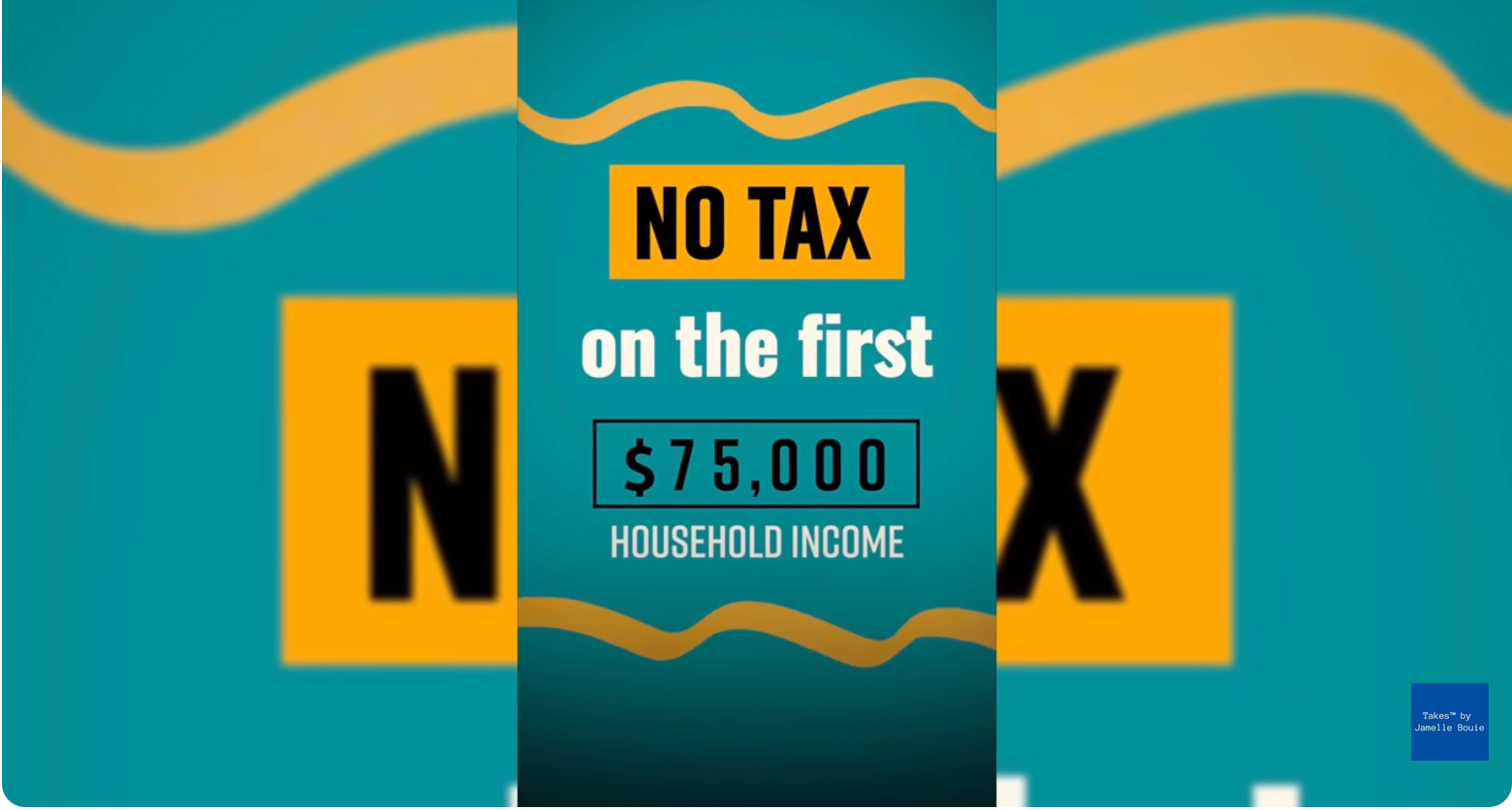
Last week a number of Democrats coalesced around a single policy idea—tax cuts. Senator and would-be presidential contender Cory Booker unveiled a plan to exempt household income under $75,000 from federal taxes—a huge jump from the current level of $31,500. The costs would be offset by raising the corporate tax rate.
Senator Chris Van Hollen proposed a similar measure with slightly different numbers. Then Katie Porter, a candidate for governor of California, chimed in with a plan that would exempt household income under $100,000 from California state income taxes. Both Van Houten and Porter propose to pay for their measures through raising taxes on the wealthy.
As Bill Scher writes at Washington Monthly, these proposals are meant to address that hot new electoral buzzword, “affordability.” Democrats believe they lost in 2024 because of inflation and anger at the high cost of living—with some justice as analyst G. Elliott Morris has explained. There are a lot of ways to address affordability, but one of the most straightforward and apparently commonsensical is simply to cut taxes so people have more money in their bank accounts. If you have more money, everything’s more affordable. You have hacked the electoral formula for infinite winning. Yay?
—
Everything Is Horrible is entirely funded by readers. If you find this piece valuable, please consider becoming a paid subscriber so I can keep writing. It’s $5/month, $50/year.
As you’ve probably guessed by this point, the answer to that “Yay?” is very much “pppppffft.” Radically raising taxes on the wealthy is a smart, virtuous, and very popular measure. But using the money generated to fund a middle-class tax cut is bad policy and terrible, terrible strategy.
We’ll take each of those in turn.
Bad Policy
Why are middle-class tax cuts bad Democratic policy? Well, the first issue is that it would cost a huge amount of money. Booker’s plan amount to a $6.3 trillion revenue cut for the federal government over 10 years, according to the Tax Foundation. That money would mostly go to taxpayers in the 40th to 90th percentile. In other words, Booker’s plan funnels literally trillions of dollars virtually everywhere except to the people who need the most help affording housing, education, and food. It’s a horrifically regressive tax plan.
Scher astutely points out that the fact that the tax cut is targeted at the middle class rather than the poor is probably intentional. “For a senator looking in the mirror and seeing the next president, offering tax relief to voters who may not need it but feel they do is a feature, not a bug,” Scher suggests. The middle class is more likely to vote, while those at the bottom of the income scale tend to pull the lever for Democrats anyway. If you need to hand the affluent a big fat giveaway to bury MAGA, less money for social programs is a small price to pay. Yay?
Or, you know, maybe not so much. The problem with Booker’s tax cut proposal, as Jamelle Bouie explains, is that “it’s basically not responsive to the actual challengers facing many middle income Americans.” He goes on:
Those challenges aren’t actually a high tax burden. Those challenges are that there’s little direct state support for middle income families and that the kinds of goods and services that might make middle incomes more sustainable like well-funded schools, like publicly funded even free higher education, like publicly funded and universal health insurance like more robust pension programs for retirement.
Those are the things that middle income families lack. And reducing a tax burden saving people around a thousand dollars, maybe two thousand dollars annually, doesn’t make up for [any of these problems.]
This isn’t just Bouie’s opinion. G. Elliott Morris has analyzed survey data about what voters mean when they say they are worried about “affordability.” His conclusion is that they are absolutely not just saying, “I need slightly more money in my pocket.” Instead, he explains
when people use the words “affordable” or “affordability,” they also tend to express concerns about high prices and (loosely speaking) low social mobility. High prices is not just about goods and services, but many things associated with economic (im)mobility and uncertainty about future prosperity in general. People mention groceries and rent, sure, but also health care, education, houses — and, yes, taxes. People also say affordability is about fairness and economic inequality (one respondent to a recent poll said things would be more affordable if we taxed billionaires at a higher rate).
When people say that US society is not affordable, they are saying they’d like to pay less for groceries. But they are also very much saying that US society is constructed in a way that is inhuman, cruel, and un-navigable for everyone but the ultra-rich.
Changing that is possible. The US is a very wealthy nation; we can afford universal health care; we can afford free public universities; we can afford a massive investment in post offices and libraries to strengthen our social infrastructure and create jobs for those with and without college degrees; we can afford to build housing—and on and on.
But we can’t afford to do these things if we’re not willing to muster the resources to do so. And the easiest, most straightforward, most effective way to muster those resources is through taxes.
Much higher, exorbitant, extractive taxes on the wealthy are necessary and good, both to raise money and to reduce inequality. But that in itself is not going to be sufficient. Social programs that transform society cost a lot and require sweeping buy in—a buy in that’s only possible if people feel, and are, invested. “For both practical reasons and symbolic reasons,” Bouie says, “if you want a broad set of middle-class benefits, then I think you need a broad-based middle-class tax.” And, crucially, there is strong reason to believe that voters do in fact want a broad set of middle-class benefits—and that they will ultimately be disappointed with, and unsatisfied with, Cory Booker’s sad, timid less-than-half measures.
Strategic Disaster
Bouie notes that treating tax cuts as the only way to approach affordability plays into the right- wing neoliberal default, which has convinced us that we cannot address our problems through collective action. He’s indisputably right—and I think it’s worth talking briefly about what this kind of acquiescence to right wing narratives leads to in practice.
In his excellent 2020 book All-American Nativism: How the Bipartisan War on Immigrants Explains Politics as We Know It, Daniel Denvir argues that Democrats helped elevate Trump by embracing the right’s talking points on immigration. Obama and his party decided that the best way to undermine the right’s xenophobic, bigoted fear-mongering was to be tougher and tougher on immigrants, doubling down on border enforcement and deporting a massive 3 million people in eight years.
The Democrats—up through Biden’s last year—hoped that draconian border enforcement and harassment of immigrants would satisfy right-wing worries about security, setting the stage for a grand bargain in which Democrats could push through amnesty for some like the Dreamers and a streamlined path to citizenship for other undocumented people. Democrats hoped that this would also defuse immigration as an electoral issue, allowing them to make an end run around bigotry without ever having to actually confront or even necessarily denounce it.
But the bargain never happened and the issue was never defused. “Instead,” Denvir writes, “these actions [of border enforcement] manufactured the threat and made it seem all the more real.
The failure to achieve compromise was in part because GOP leaders like Trump wanted to run on immigration and simply blocked any deal that would undercut their nativist appeals. But it was also because the GOP had no need to make a deal when Democrats had already ceded them so much ground on policy. Republicans could simply block any effort towards amnesty and amplify Democratic calls to secure the border. With both parties claiming that the border was a problem, most voters came to see anti-immigration attitudes as bipartisan common sense—creating the ugly primordial soup of bigotry from which Trump has crawled, trailing his fascist slime behind him.
The parallel with Democratic embrace of tax cuts should be clear. Democrats are embracing low taxes on the middle class as a way to try to steal Republican thunder; they hope it will also provide them with leverage to raise taxes on the wealthy. But looking at the history of immigration debates of the last decades, we can say that the grand bargain Democrats seek is unlikely to happen.
Instead, Republicans will block the tax hikes on the wealthy while embracing tax cuts for the middle-class, devastating government revenue and making it completely impossible to pay for any social programs. Worse, the GOP will point to and amplify Democrat’s unilateral ideological concession on taxes to build a broad conventional wisdom that all taxes are illegitimate. As tax revenue plummets, inequality will worsen, social programs will disintegrate, the US will become ever more of an unaffordable dystopian neoliberal hellscape—at which point Republicans and Democrats alike will advocate for more tax cuts, in an endless vicious spiral to a fractured, impoverished, desperate society, in which the only jobs are in the heavily militarized police force or serving as powerless indentured servants to rabidly fascist oligarchs.
You can’t fight fascism by embracing fascism lite; you can’t defeat oligarchy by insisting that the oligarchs are right about everything. We arrived at this miserable authoritarian regime in part because the opposition party kept ceding ground to bigotry till there was no ground to cede. Now Cory Booker and others in the Democratic party are clamoring to abandon even more territory, validating the anti-social talking points and policies of the worst, wealthiest people on earth. Democrats need to tell all of these neoliberal dopes that Booker’s plan, and all those like it, are a nonstarter—a shit policy and shit strategy which will benefit no one but Trump and his rancid ilk.
It's astounding the number of things many Democrats think drive voting behavior and polling but actually don't really matter much, at least compared to bigger things like racism/sexism, partisanship, and vibes. Like they fundamentally don't understand how politics works. Otherwise they probably wouldn't keep trying to be Republican lite.
An incredibly bad idea, brought to you by Vichy Democrats.