

Some Republican bullshit artists like Dinesh D’Souza like to claim that the Republican party is the one and only champion of Black rights from the time of Lincoln until today. In response, Democrats often point out that during the Civil Rights Movement, the GOP and the Democrats switched places. The Republicans—the party of the Union, the party that had freed the slaves—embraced white supremacy. The Democrats—the party of the Confederacy—became, under Lyndon Johnson, the party of multiracial democracy.
The GOP narrative is bad faith bullshit, obviously. But the Democratic response is also misleading. The two parties did not flip. Rather, the two parties became polarized around an issue—white supremacy—where they had previously been in (white supremacist) agreement.
This is not just a technicality. You can’t understand partisanship or democracy in this country if you skip over the most important bipartisan consensus in the nation’s history. Said consensus being the commitment to the authoritarian subjugation of Black people which has defined US politics from its inception, with only sporadic and halting exceptions.
—
Everyting Is Horrible relies entirely on reader donations. If you find this piece valuable, please consider supporting me so I can write more such. Paid subs are $50/yr, $5/month.
Bipartisan white supremacy has been the norm
I’ve discussed Julia Azari’s book Backlash Presidents before—and I’m going to discuss it again here because it’s an excellent corrective to the “Ds and Rs flipped” narrative.
Azari points out that for most of US history, presidents and politicians of both parties worked hard to avoid confronting racial inequality. In the antebellum era, figures like Martin Van Buren and Daniel Webster negotiated or promoted a series of compromises which were intended to defuse growing tensions around slavery, generally by reassuring the South that no one was going to take their slaves from them. Or as Azari puts it, presidents of the era, were dedicated to “avoiding the major moral confrontations while keeping a careful eye toward compromises that would preserve the Union.
Eventually, however, Southern demands to expand slavery (through adding salve states and through fugitive slave laws) made compromise impossible, and the Republican party emerged. The GOP was Northern, but even more importantly, it was anti-slavery, both in the sense that it stated explicitly that slavery was wrong, and in the sense that it set itself firmly against the expansion of slave power. After 75 years of avoiding the issue, the major parties were finally polarized around a core issue of racial justice. The result was the Civil War.
D’Souza and his ilk pretend that the GOP has remained the party of racial equality up to the present day. Even Democrats tend to suggest by default that Republicans were the party most sympathetic to Black rights into the 20th century. But neither of these things is really true. On the contrary, as Azari notes, the GOP started to back away from their civil rights commitments even before the war ended.
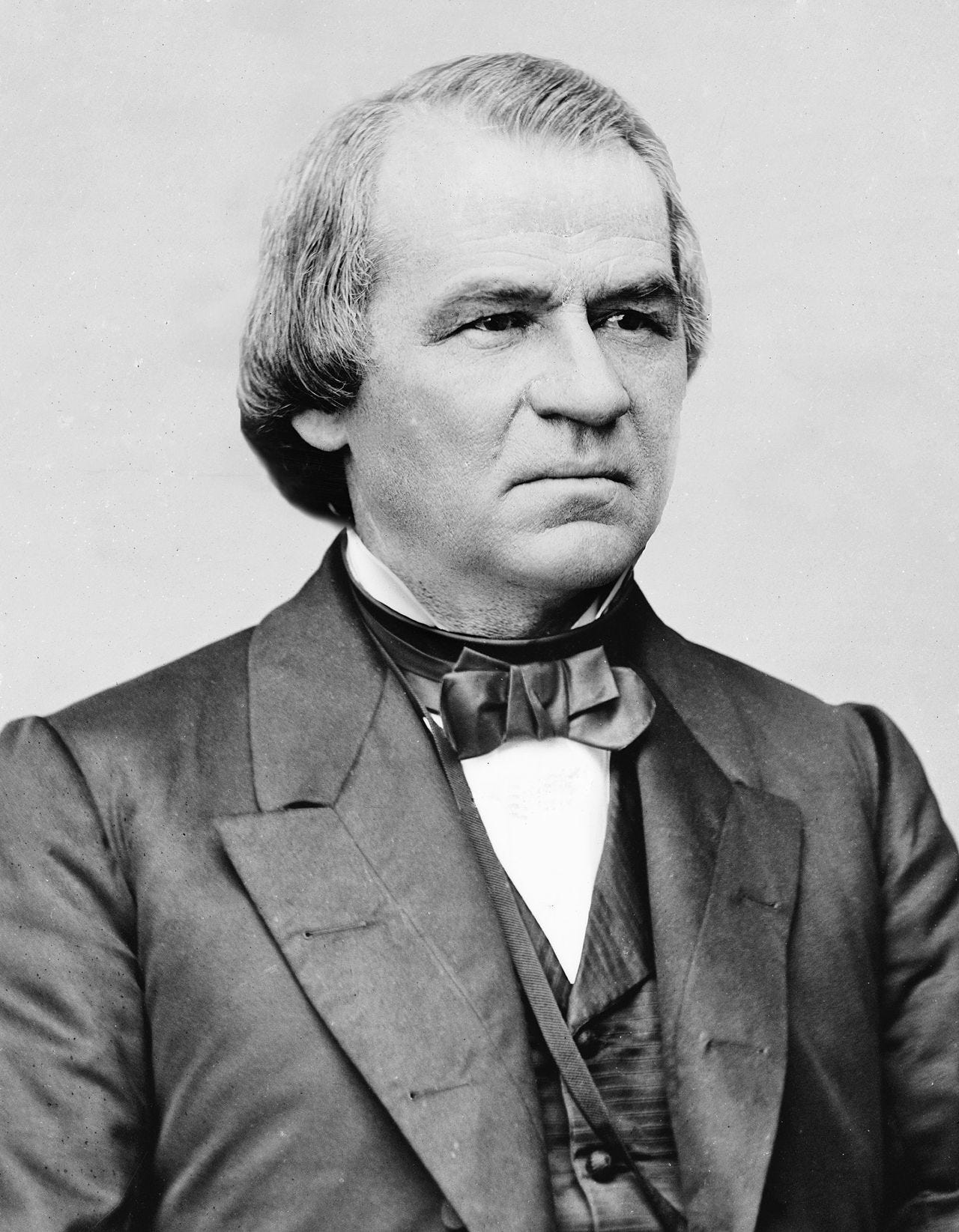
Lincoln (fatefully, horribly, cynically) appointed racist asshole Andrew Johnson as his vice-president for his reelection bid in 1864. Republicans in Congress passed the 13th and 14th amendments over Johnson’s objections, and after his election in 1868 Ulysses S. Grant fitfully and half-heartedly tried to protect Black people from mass KKK terror campaigns in the South. But that was it; by 1877 the GOP and Democrats reached a détente in which they both agreed to the mass disenfranchisement of Black people in the South while turning to the business of native genocide at home and imperial adventures abroad.
This period—sometimes referred to as the nadir of American race relations—continued for a century. Both parties accepted and promoted Jim Crow; both parties opposed anti-lynching legislation. Sometimes a Democratic president like Truman would integrate the armed forces, or a Republican president like Eisenhower would send troops to enforce school desegregation. But both parties were careful to avoid associating themselves too closely with civil rights, because both saw white power as inseparable from their political power.
When Johnson decided (belatedly, with limits, but still) to embrace the Civil Rights Movement, then, he was not taking up the position of the contemporary Republican party. Rather, in abandoning a policy of bipartisan compromise and polarizing his party against white supremacy, he was paralleling the actions of a GOP from 100 years previous.
The parties did not flip, because on the issue of white supremacy they were not opposites. It was only after Johnson’s Civil Rights bills that there was a meaningful distinction between the parties on the issue of Black rights. You can’t switch places when there’s no one to switch places with.
Bipartisanship is the problem, not the solution
Republicans in the 1860s and Democrats in the 1960s were tearing up a bipartisan consensus in order to adopt a position—support for multi-racial democracy—that previously had had no partisan support. Individual actors of various parties in office might work towards multi-racial democracy; protestors outside government might work towards multi-racial democracy. But neither party was committed to opposing white supremacy, which meant that there was no way to vote against white supremacy at the polls and no real path towards consistent progress.
It’s crucial to understand this because so much of our political culture is devoted to denouncing partisanship and praising compromise. Academic researchers, think tanks, and the media constantly warn of the dangers of partisanship and division. If only we could really talk to each other and abandon our allegiance to party, the story goes, we could find common ground.
And maybe we could. The problem is that historically the common ground has been white supremacy. And over the last 75 years of increasing partisanship, Democratic bipartisan gestures have been deliberately designed to move the party back towards white supremacy. Bill Clinton’s Sister Souljah moment—performatively bashing a Black musician—and his third way eagerness to gut welfare were both strategies intended to tell white voters that Democrats could still do white supremacy.
Biden’s eagerness to pass a draconian anti-immigrant bill and take the issue off the table for Trump similarly harked back to those pre-Civil War compromises which were meant to take defuse slavery. When reactionary centrists like Matt Yglesias and Gavin Newsom advocate restrictions on trans rights, they’re trying to find a bipartisan bigotry that will make Democrat’s association with civil rights seem less thoroughgoing, less partisan, less confrontational.
There’s a good bit of evidence that the Newglesias approach is electoral poison. But it is also a moral atrocity. Historically, before the Civil War, after Reconstruction, and (more waveringly) in the Clinton presidency, bipartisanship is where multi-racial democracy goes to die. When a party of multi-racial democracy emerges and is willing to fight, it can win—even if the cost, as with the Civil War, is very high. It’s when both parties decide that bipartisan white supremacy is easier that you get chattel slavery and Jim Crow.
It’s important to emphasize that currently Democrats, not Republicans, are the party on the right side of racial justice issues. But it’s just as important to emphasize that for Democrats to stay on the right side of those issues, they need to become more partisan, not less.
We are not going to get multiracial democracy through bipartisanship. We are going to get it, if we get it, through a hyperpartisan Democratic party willing to gerrymander the fuck out of blue states, expand the Supreme Court, enfranchise DC and other territories which want it, hold tribunals, and toss Ted Cruz and Josh Hawley out of the Senate for supporting a treasonous insurrection.
The story that Democrats and Republicans flipped in the Civil Rights era is often just a shorthand. But it’s a shorthand that unintentionally erases the real transformation of the 60s. That transformation did not involve two parties exchanging positions. It involved one party abandoning a bipartisan consensus in order to make a partisan issue of justice. If we want more of that justice, we need more partisanship—and if we want a better future, we need to remember that conflict is sometimes preferable to an evil peace.
"We are not going to get multiracial democracy through bipartisanship. We are going to get it, if we get it, through a hyperpartisan Democratic party willing to gerrymander the fuck out of blue states, expand the Supreme Court, enfranchise DC and other territories which want it, hold tribunals, and toss Ted Cruz and Josh Hawley out of the Senate for supporting insurrection."
The tribunals need to be thorough, ruthless, and very public. They also need to end in executions. Leaving any of these bastards alive after what they've done and what they'll do in the next few years would be equivalent to suturing a stab wound without disinfecting it and leaving shards of rusted metal embedded in the underlying tissue.
Excellent work, Noah!