

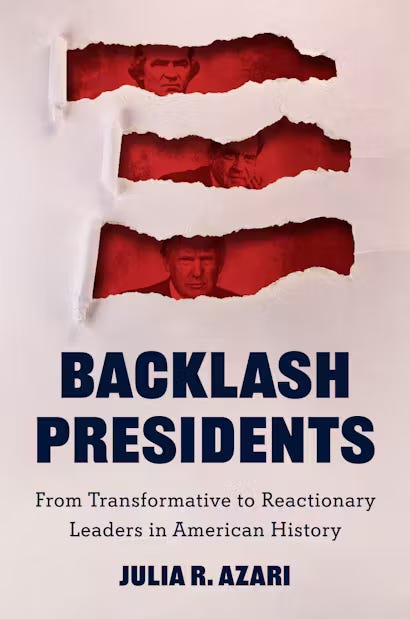
Trump is often discussed as if he and his presidency are unprecedented, unpredictable, and a shocking departure from American norms. But Marquette University political scientist Julia Azari sees Trump as part of an ugly but lineage.
Azari’s 2025 book Backlash Presidents: From Transformative to Reactionary Leaders in American History looks at three key presidents who oversaw racial transformation in US History—Lincoln, Lyndon Johnson, and Obama. Each of these presidents upset the racial status quo and pointed the way to a more equal society. And each was followed by a backlash president—Andrew Johnson, Nixon, Trump, who seized authoritarian power in an effort to re-solidify white supremacy.
These backlash presidents, Azari argues, each engaged in Constitutional overreach. That overreach led to impeachment. But the impeachment did not beat back the backlash. Instead, the backlash presidents, and the movements they represented, managed to blunt and reverse racial transformation, ensuring that the US would continue as a nation with white supremacy somewhat battered, but ultimately intact.
This history obviously has some ominous lessons for our current moment. But Azari sees some hopeful signs as well. I talked to her about the presidency, racism, backlash, impeachment, and where we go from here. (I’d also urge you to check out her group newsletter, Good Politics/Bad Politics, which she writes with Jonathan Bernstein and David Bernstein.)
This interview has been edited for length and clarity.
—
Noah Berlatsky: People often think that there’s steady racial progress; each President does better than the last. And instead in your book you argue that we have long periods of presidents basically trying to find an acceptable compromise with white supremacy, and that’s interspersed with these moments of racial transformation followed by backlash.
Julia Azari: That’s accurate.
The idea that presidents mostly are racially cautious is not original to me. It doesn’t have nearly as much written on it as it should, but there are a couple of books from the 90s that go into this. There’s also a book called The Black Presidential Nightmare that lays out how each president was a nightmare for African Americans in their own way. But the angle where there’s a connection between racial transformation and then their successors getting impeached—it took longer to elucidate what exactly the connection was there.
When people talk about the current moment, they often argue that there’s too much partisanship, and we need more compromise. But you point out that “compromise” often means, “how can we continue some form of white supremacy?
Right. And the interesting thing about this is that you literally saw this in 2017 with this whole conversation around, “How can we move away from identity politics?” And, “Maybe the Democrats have gone too far.”
They’re still doing it right? “Oh no. The groups will get their way.” And it’s like, okay, who are the groups? Who are these nefarious groups?
Right. And it’s the same people making those arguments.
So the interesting thing about this is [the people they’re targeting] are essentially the same people that are Nixon’s enemies list. It’s the people that Nixon wants to get the FBI to spy on. I mean, the form changes somewhat, but it’s the same general idea of [targeting] people who want to criticize the hierarchy and the status quo.
So, going back to the intellectual kind of origins of this project around 2017, it’s very much a time where people are talking about, “We’ve lost the center!” And then what gets added to the conversation about polarization is this conversation about norms.
And I want to sort of give credit where credit is due. I was feeling sort of uneasy about some of the ways that people talked about norms as they pertain to American democracy. But Corey Robin wrote what I think is sort of the like definitive online piece about this saying, you know, actually norm violations are critical part of the democratizing process. And that was really important to my thinking.
What becomes clear is that there’s this through line where this conversation about, “Can’t we just moderate? Can’t we all just get along? Can’t we find the center?”—that has historically, explicitly been linked to fights about race.
There are important ways in which democratic norms underpin our system and in which we are dependent on informal practices. We are dependent on democratic values. So I don’t want to throw norms out. At the same time, in American politics, race tends to be at the center of the thing that we create norms around in order to avoid.
The angle of what presidential power means here is, I think, central. There’s a reason I wrote this book about the presidency and not the courts.
Could you talk about that more?
I think the power of the presidency is really crucial here. A number of people have asked me about the courts. What about Brown v Board?
And my answer is that the courts don’t exemplify power the same way the presidency does. And this has just increased over time. The President is not only the enforcer of the laws, the President is not only the person on top of the growing administrative state, not only the legislator in chief, not only the symbolic face of the nation, right?
It continues to build over time to the presidency that we have now. And that, I think makes for a good explanation for why Obama’s presidency was so racially explosive when the policy intervention of his presidency was so minimal compared to [Lincoln and Lyndon Johndon]. You have a fundamental reshaping of the country in the Civil War. You have landmark legislation and further growth of the power of the federal government in the 60s.
And then with Obama, you have someone who said that if he had a son, he’d look like Trayvon Martin. Obama occasionally makes reference to the fact that race exists and it affects people’s lives, including his own. And we’ve now merged the power of the presidency with this anxiety that this means people of color are going to get more power, right? Specifically going to get power in a zero-sum game with white Americans.
The key impact of that is to make even some people who had actually voted for Obama really embrace racial backlash and racial threat. Other people have done more quantitative work to suggest that this is connected to identity and immigration attitudes.
As you say in the book, it’s obviously about a Black man being president. But also since Lyndon Johnson, there’s been a long Democratic realignment as white people have sorted themselves into the white identity party. And Democrats have spent 50 years trying to finesse that. That’s what Bill Clinton was about; signaling in various ways that he was a white identity politician. Even Obama made some of those gestures.
But at the point where you elect a Black man, it becomes clear that you have this coalition, which is basically everybody but white men, and it can win.
And that’s explicitly the issue with immigration. They’re saying none of these people really should be able to vote. You have a coalition of Hispanic people and Black people and queer people and women, that can win, and a coalition that is consistently not led by white men and not really centering white men. And I think the backlash is a final rear guard action to end democracy and prevent that coalition from ever winning again.
I think that’s a read of the situation. And I think that my book does less of trying to delineate the exact definition and boundaries of the situation that you’re describing and more trying to put it into this historical narrative. I was pointing out that actually, this is what we do, and then it plays out in these very specific ways that don’t necessarily look racialized on the surface, but are in fact racialized
So I’m looking less at cause and more at impact. And part of what that impact is, is that we have these impeachment crises that don’t necessarily look racialized but are very much the product of the racial politics of their time and are linked to racialized institutions.
And so when we talk about executive branch lawlessness, we should realize that that is a racial project. And one of the key implications for our life in 2026 is we can’t sit around talking about saving democracy and then throw unpopular minorities under the bus. Those two things are not compatible. So it’s a lot more normative than my previous work. But on the other hand, I think we’re at this moment, we need to talk about how things should be, or else we’re going to lose the thread even more than we already have.
One of the interesting things you say is that impeachment is often led by Black lawmakers, that Black lawmakers are often the people who are most too keyed into the fact that this is a crisis about race and are most eager to restrain a president who is pushing a supremacist agenda.
Basically yes, and I think that’s important.
There’s a debate about how much is impeachment legal? How much is it political? And my argument is there’s a two-step. You need this political foundation, and that tends to come from Black lawmakers and or their allies. And then you have the legal part where, once the political foundation has been established, they look for discrete charges, and those charges often are rooted in broadly racialized institutions, like elections and the FBI. (Though you could also make the case that, all institutions in the US are racialized.)
Do you think impeachment is the right thing to do now?
I think it’s tricky right now, because Democrats are obviously in the minority, and even when they win the majority, there are going to be coalitional challenges.
But I think Democrats need to push harder to reframe the politics of impeachment in general and really think about it in terms of obligation, and move it away from the Clinton framework of, “Is this really a high crime or misdemeanor?”
The presidency has certain obligations. Here’s what the President needs to do. You haven’t done it. And use it as a mechanism for accountability. If the President isn’t fulfilling the responsibilities of their job, if they are neglecting Article Two, if they’re neglecting the 14th Amendment and equal protection, then this isn’t going to work. And our country can’t go on under those conditions, right?
And as a result, we have to hold this President accountable. Because if there’s an unaccountable leader, everything else we might care about and you might want Congress to focus on is not going to work.
So you would like to see an impeachment that is more big picture.
I think you can still break those into specific charges. I just think that you want articles of impeachment linked up to constitutional obligation.
I also think that there’s been this discourse, as long as I can remember, which is back to the Clinton impeachment—that if we do this now, we’re going to have a parliamentary system, and every president is going to be impeached.
And that is the same as the “we’ve lost the center” thinking. It’s the same faulty logic. It’s electability logic. It’s all the faulty logics of caution that have driven American politics into this place.
And maybe every president from here on out will be faced with bullshit impeachment, but the threshold for removal is 67 votes. So it’s not like that’s easy to achieve. And I think we should expect that majority parties in the house generally don’t perceive this to be worth their time. You have to lay out the case for why this is worth your time in a given moment.
You can’t argue, “We can’t do this because it could become a problem.” Every category of thing could become a problem. You have to commit to the specifics of this specific thing. Commit to the specifics of a specific situation and say, you know, whatever happens after this, it’s not our problem right now. We have to solve the problem that we actually have. We have to worry about the most important thing, rather than worrying about this hypothetical thing that might happen.
I feel like that about expanding the Supreme Court. The court will block everything if you don’t expand it—ideally by a lot, like I’d put fifty judges on there if I could.
And people sometimes say, well, if you do that, they’ll just add more judges. And my response is, “Fine!” Let them add more judges. At least we’ll have a reasonable court every so often, rather than a right-wing nightmare now and forever.
I think that’s exactly right. There’s a certain way you want to think about game and strategy and politics, and then there’s a certain way that it just becomes completely paralyzing.
And that’s my thinking on the politics of caution around impeachment. Should you do it because you don’t agree with someone? No, but I don’t think there’s any reasonable argument to be made that we have over-impeached.
And I think it’s quite telling that George W. Bush and Barack Obama were very polarizing and had very strong opposition. And in Bush’s case, he was quite unpopular for a period. But they were not impeached.
We’re living through the most violent backlash since Redemption in a lot of ways. Do you think we’ll end up in a better place than we did then? What are things that make you optimistic and what makes you pessimistic right now?
The thing that makes me the most optimistic right now is—you know, I tell my students I’m pro polarization, just to irritate them and provoke them. But I think that’s polarization is actually the most hopeful thing.
Typically in these periods—after the Civil War, and specifically after the end of Reconstruction; after the Civil Rights Movement— the Republican Party and the Democratic Party, respectively, in those eras, rolled over. They did as much as they could to distance themselves from the chaos of the past. And the backlash party doubled down, and while they may have lost the battle with a bruising impeachment, they each won the war as far as setting the tone for the subsequent 40 years or more.
And I don’t know that that is as likely now, because while there are people in the Democratic Party, certainly, who would like to moderate and move away from impeachment and move away from the groups, but there are also people who are not interested in letting that happen without a fight.
Right. And the reason they’re not willing to let it happen without a fight is because it’s LGBT people who are looking down the barrel of the government trying to exterminate them; it’s Black people who are looking at not being able to vote again. And the same with Hispanic populations. It’s people who don’t have room to back up.
Exactly. They don’t have any incentive to do that.
And also, these groups relative to 70 years ago or 170 years ago, are pretty well-organized and have some power. And so I think we’ve passed a certain threshold of distributing power where we’re not going to flip as easily.
And that’s really what gives me some hope, is that there are fewer mealy-mouthed moderates on these issues. So you know, sing it from the rooftops, sometimes polarization is valuable. Not always. But not every element of polarization is indicative of a problem. And I think that’s the most encouraging version of this.
I think the less encouraging version is that we have an authoritarian movement that is very determined to consolidate power and has been really successful in doing so in the executive branch, and we as a society have basically spent decades denigrating every other form of counter power. So whether it’s Congress, whether it’s political parties, whether it’s unions, whether it’s civil society organizations, now we don’t have a lot of centers of of power to counter the executive. We have a very atomized society.
The NAACP is quite organized and powerful, the Human Rights Campaign is quite organized and powerful. So these specific minority groups are still really motivated, organized and powerful. But your average person who’s not a member of those groups might have once been a member of a union or the Democratic Party. Or you might have had a member of Congress who saw themselves as sort of distinct from the president’s party. And none of those things are nearly as true anymore.
.It’s the up and downside of partisanship, right? I mean, on the one side, there are lots of people who are really committed to fighting. But anybody who’s in the Republican Party in any way is just reluctant to oppose him for any reason.
I guess I would distinguish partisanship from polarization here. Partisanship is unifying the team at the expense of Congress having their own institutional pride, and that makes this moment really different than previous backlash.
But on the other hand, polarization, or deep and uncompromisable division over the structure and values of society, is better than the alternative of just compromising on those values and being like, it’s okay, some people can be second class citizens. I would prefer that people put up a legitimate fight for equality rather than jettisoning equality for the sake of moderation and unity.