

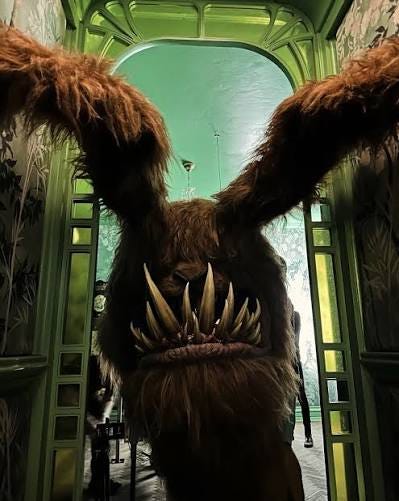
Yesterday I wrote about The Thomas Crown Affair, a tedious rich white male empowerment fantasy which trudged stolidly through the predictable tropes while (per the tropes) loudly trumpeting its innovation and unpredictability. Today, in contrast, I’m going to write about Bryan Fuller’s Dust Bunny, an empowerment fantasy that grabs every trope in sight and dumps it into the mouth of a giant fanged bunny.
—
Everything Is Horrible relies on your donations. If you value by writing, please (please!) consider becoming a paid subscriber. There is a 40% off sale now; $30/yr. Hit that button!
—
Part of what’s so wonderful about the (weird, ravenous, adorably fuzzy) empowerment fantasy offered by Dust Bunny is that it’s so upfront about the fact that it’s a fantasy. The film starts out in the same kind of space of magic children’s logic as Alice in Wonderland, Time Bandits or Labyrinth. Eight-year-old Aurora (Sophie Sloan) is terrified of a monster living under her New York apartment bed; she fears it will eat her if she touches the floor.
Aurora’s parents understandably doubt the existence of said monster, and we aren’t sure what to believe either. The camera catches shadows and rumbling and floorboards rising disturbingly. But are we supposed to understand those hints as real in the film or just as a fantasy within a fantasy? We know anything can happen in a movie, but we don’t know what level of anything we’re dealing with here. Director Fuller, by forcing you to constantly try to figure out how much disbelief to suspend, makes you constantly aware you’re suspending disbelief, even as it forces you into the position of a child who hasn’t quite figured out which parts of the world are real and which parts are in her head.
The movie eventually does explain itself—but almost always in ways which preserve the dream-like improbability. Parents are devoured offscreen as Aurora hides under the covers. She follows her neighbor in 5B (Mads Mikkelsen) into Chinatown, where she dons a stylized bunny mask and watches him fight a Chinese dragon, or maybe men who make up a Chinese dragon. She steals money from the collection plate at a rock and roll hip-swinging Church service as surreal as anything else in the film, and then offers to hire 5B to kill her monster. It turns out he’s an assassin, and thinks her parents were killed by people trying to get him. Threats on her life, and his, escalate from there, culminating in a extended, improbable assassins vs. FBI vs. tunneling bunny monster free-for-all, in which everyone tries, with more or less success, to stay off the floor.
Is an assassin as your next-door neighbor really more feasible than a creature under the bed? Would the FBI really be investigating a child protection issue? Even when the film is “real” it’s not especially real. And yet, the core of the film, around which the varying levels of nonsense swirl, is Aurora’s trauma, and the way that trauma bonds her to 5B. Which feels very real indeed.
Aurora’s monster came into being, she says, when she wished for it to appear and devour her parents because they were not being nice. We never learn exactly how they were not nice, but her lack of affect when discussing them, and the refusal of details, suggest grim possibilities. The monster which eats her parents is both her salvation in this case and a metaphor for her parents themselves—and perhaps for the foster families who have adopted her and disappeared in turn.
Aurora is a solemn, stubborn child, courageous in pursuing safety and affection even as she remains firm in her belief in horrors. So firm that she makes you remember, amidst all the improbabilities, that there re in fact horrors visited upon children, not infrequently by their own parents.
(Spoilers coming if you care about that sort of thing.)
Mikkelson plays 5B as a soft-spoken skeptic of certain monsters and a weary believer in others, not least his own boss Laverne (Sigourney Weaver) who is also his mother. Her interactions with him are annoying and hectoring rather than abusive—except for the part where she tries to have Aurora murdered because the child has seen 5B’s face. Oh and she also starts snarking at one point about how she thinks it’s a bad idea for 5B to try to heal his childhood trauma by adopting a daughter.
Aurora stands up to Laverne more consistently and effectively than 5B does—not least when her monster rises from the subconscious repressed space under the floorboards and devours the evil mother. That’s the empowerment part; Aurora realizes that the monster she wished for is hers; facing her fears gives her power over them and over those who would hurt her. She’s a superhero, and her superpower is a giant slavering (though also kind of cute when it comes out into the light) subterranean underbed bunny.
You could see Aurora’s power as a metaphor for her determination and resilience. You could also see it as a metaphor for her growing relationship of love and care with 5B. But perhaps the most poignant reading is that her superpower is not a metaphor at all, but a fantasy. This is a film. It’s telling you things are all right, but that’s what films do. It’s not real. There are no monsters under the bed and no noble assassins to save kids from the monstrously powerful people who can ruin their lives.
The frolicking demon bunny shadow running along beside the car that takes Aurora and 5B into the sunset is simultaneously a cute victory lap and a reminder that monsters are not so easily evaded as Hollywood often likes to suggest. You can leave the apartment and find a new home, but trauma will be under that bed too. Dust Bunny follows the script at least insofar as everything turns out okay. But its power is that it knows it can only maintain that fiction by not looking too hard at what’s under the floor.
Dust Bunny was an insanely weird movie, but I enjoyed it. The cast was spectacular!