

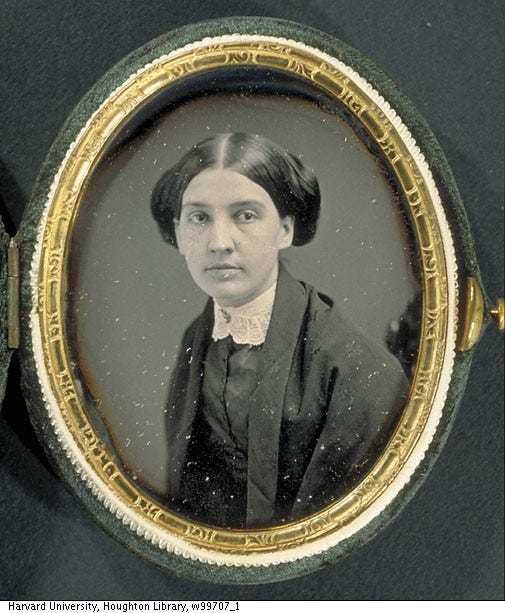
Emily Dickinson was a New England writer associated with abolitionists like Thomas Wentworth Higginson and Ralph Waldo Emerson. Nonetheless, she herself rarely talked directly about slavery, and her poems were occasionally quite racist. One example is her bitter poem of thwarted love, “The Malay–took the Pearl–”, published in 1862, in the middle of the Civil War. It is, I think, a early example of a dynamic familiar from our own era, in which failure triggers bigotry—the compensatory animosity of white entitlement.
The Malay—took the Pearl—
Not—I—the Earl—
I—feared the Sea—too much
Unsanctified—to touch—
Praying that I might be
Worthy—the Destiny—
The Swarthy fellow swam—
And bore my Jewel—Home—
Home to the Hut! What lot
Had I—the Jewel—got—
Borne on a Dusky Breast—
I had not deemed a Vest
Of Amber—fit—
The Negro never knew
I—wooed it—too—
To gain, or be undone—
Alike to Him—One—
—
Everything Is Horrible is made possible by your contributions. If you like my writing about poetry, consider becoming a contributor so I can keep scribbling! It’s $5/month, $50/year.
—
The Dickinson bloggers at the Prowling Bee explain that this poem is probably referencing the love triangle between Dickinson, her brother Austin, and Sue Huntington Gilbert. Emily and Sue had a passionate intellectual, emotional, and probably romantic relationship; Emily compared her feelings for Sue to Dante’s for Beatrice. Sue married Emily’s brother in 1856, however, and Emily and Sue’s relationship became more distant—especially perhaps after Sue had her first child in 1861.
“The Malay…”, then, is a poem about Emily’s grief and heartbreak—and also, I think, about her entitlement and lack thereof. The “Malay” is her brother, Austin; the “Pearl” is Sue, and Emily herself (whose name starts with E) is the (male) Earl.
The Earl is “unsanctified”, and so unworthy of—or perhaps simply considered unfit—to grasp the pearl from the sea, with all its lesbian double entendres. While the Earl hesitates, struggling with fears about propriety and stigma, the Malay/Austin simply seizes the prize. The AABB rhyme scheme (unusual for Dickinson, as the Prowling Bee points out) closes like a trap or a lock, fitting Austin and Sue together and shutting Emily out.
Emily, as a lesbian, was considered by others, and perhaps considered herself, less worthy of Sue. But Emily also considers herself more worthy—purer, more feeling, more in love. And she expresses that sense of her greater worthiness by imagining her brother as a Black man, who takes the prize while she hesitates.
Home to the Hut! What lot
Had I—the Jewel—got—
Borne on a Dusky Breast—
I had not deemed a Vest
Of Amber—fit—The Negro never knew
I—wooed it—too—
To gain, or be undone—
Alike to Him—One—
The five-line stanza feels almost panicked as the syntax twists and hesitates and garbles. She imagines Austin taking Sue “Home to the Hut!”—a domestic and/or sexual reference which sends her back to imagining her own possible happiness and loss “What lot/Had I—the Jewel—got.” Then the poem jumps again to the sensual image of Malay and pearl, (“Borne on a Dusky Breast—“) before the stanza closes with an off-kilter disavowal, in which Emily’s own misplacement in the couple is underlined by an extra fifth unrhyming line. “I had not deemed a Vest/Of Amber—fit—” are lines that don’t fit, cracking out of the quatrain, and out of identity and meaning.
Emily could be saying that the Malay’s, or Austin’s, vest, or breast, is not fit for the pearl. But the phrasing suggests that she “had not deemed” it fit in the past, before the poem starts, when she was contemplating the pearl but the Malay had not yet entered the water and the chase. Emily then may be imagining herself as Black, or as stigmatized, insisting she has rejected the “Vest/of amber” while also suggesting that the vest “fit.” Paranoid fantasies of Black male rapists did not proliferate till after the Civil War, but the censure of Black men marrying or having relationships with white women was certainly in place in Dickinson’s day, and functions here as a displaced taboo—Dickinson projects her “wrong” desires onto her brother.
Those wrong desires aren’t exactly parallel though. Emily’s same-sex interests are too much and too intense, overflowing the “fit.” In contrast, Austin’s “Malay” love is framed as insensitive or unknowing—in accord with 19th century white supremacist medical theories which justified torture, family separation, and slavery on the grounds that Black people had a higher tolerance for pain and were generally insensitive. The final stanza of the poem presents the “Negro” as oblivious to the Earl’s efforts, but also as indifferent to his own. “To gain, or be undone—/Alike to Him—One—”. Austin is presented as Black because he doesn’t care about Emily, and possibly because he doesn’t care about Sue—whose name rhymes with knew/wooed/too in that final stanza, a last moan of pain before Austin and Sue become “One.”
Obviously, 1862 was a long time ago, and the exact contours of racism have changed a good deal since then. But there’s still a lot here that resonates uncomfortably with our current moral panic about DEI, affirmative action, and desegregation.
Dickinson feels that she has been robbed, or cheated, or discriminated against—and, since she’s talking about same sex attraction and love, there’s a good case that she has been discriminated against. But she doesn’t have a gay rights frame to think about her experience of being shouldered aside—and so she defaults to the affect and structure of racism. When she imagines losing her rightful claim, she imagines losing the entitlement of whiteness, which is to say, she imagines losing her rightful claim to a Black person. Humiliation and Blackness are inextricable; the first calls the second into being. For Dickinson, to imagine herself in the position of a Black person is to imagine herself being dispossessed by a Black person.
Dickinson’s poem uses the same structure of prejudice that fueled the reverse colonial fantasies that are usually dated to the end of the 19th century. In novels like The War of the Worlds, or Dracula, or The Beetle, the evil nonwhite other does to white people what white people did to them—conquering land, enslaving people, dispossessing property and selves. And this, in a nascent, slightly more elliptical form, is also what is happening in Dickinson’s poem. Because Black people have been robbed, they become a symbol of robbery; because they have been dispossessed, they embody the terror of dispossession.
“Malay…” is a poem about being mistreated and stigmatized; it’s a poem about having your humanity and your love ignored and denigrated. Those are, Dickinson realized, common experiences for Black people as well. But, Dickinson in this poem did not respond to that insight with solidarity. She responded, instead, by blaming Black people for her troubles. That’s how white supremacy works, in Dickinson’s day and in ours as well.
“Because Black people have been robbed, they become a symbol of robbery; because they have been dispossessed, they embody the terror of dispossession.”
Such a succinct description of how centuries of gross privilege automatically regress us back to age three maybe four. Emotionally morally and corporately, as in acting as a group.
Perfectly put.
Please continue writing…
“For Dickinson, to imagine herself in the position of a Black person is to imagine herself being dispossessed by a Black person.”
This reminds me of something you recently wrote about trans women. That for men to imagine themselves as women- to acknowledge that trans women exist- is to have their masculinity stripped. All of our hatreds have intertwined roots.