

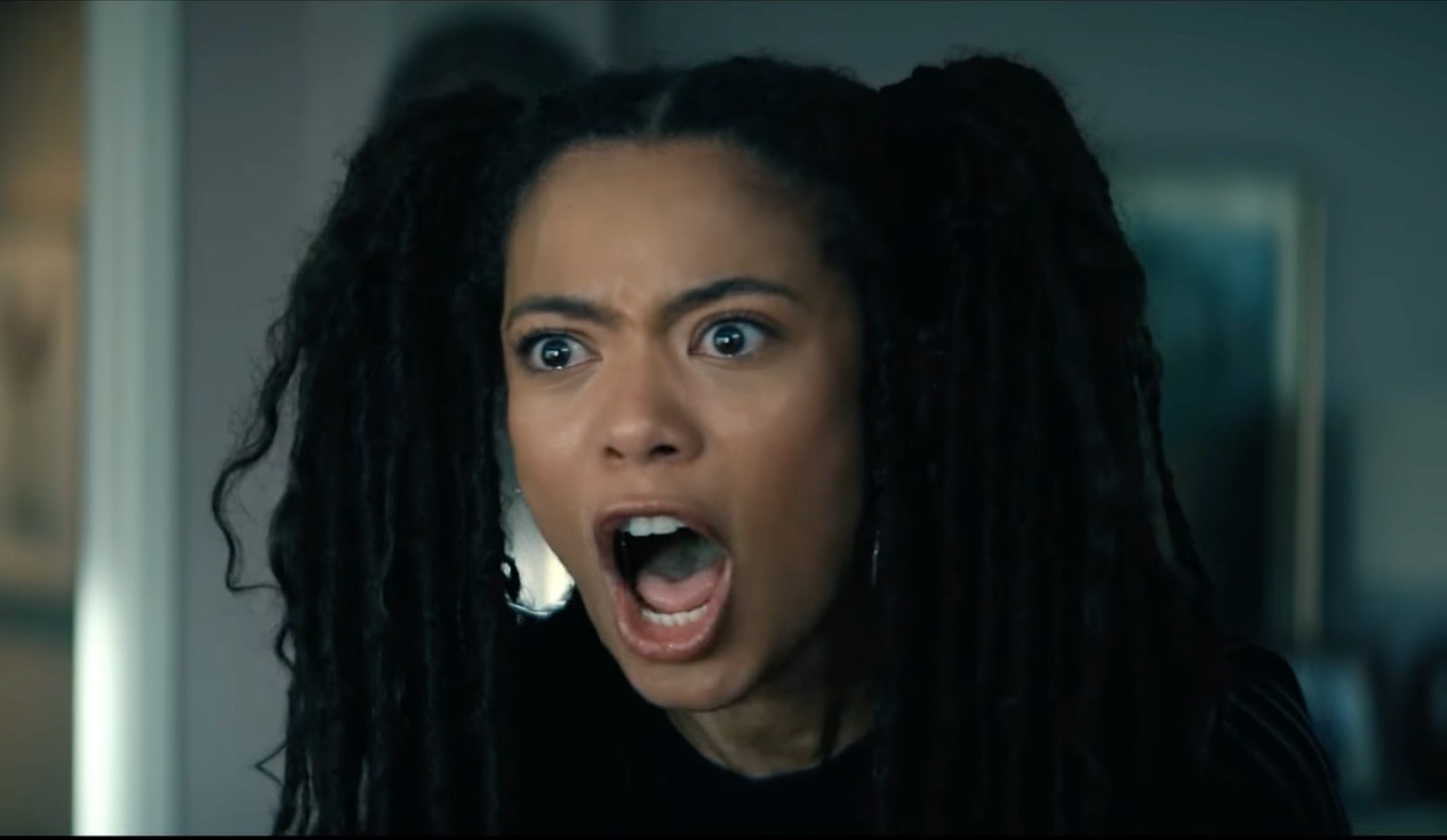
“I didn’t have any choice. My parents put a drug in me. They decided that for me…You just stood there and said I massacred them. You don’t know anything. I was a girl who got her period. That is it. And you make me feel like a monster for it. And you let my sister believe that I’m a monster. You let her believe that it’s my fault. I loved my parents. But they did this. Not me.”
That’s probably the most powerful monologue in GEN V season 2. The speaker, Marie Moreau (Jaz Sinclair) is talking to her aunt about the most traumatic moment of her childhood. Marie was injected with Compound V, a super serum created by the Vought company, when she was very young. On the day she got her period, she discovered she had the power to control blood—and, in a panic, without control over her power, she struck out with the blood from her own body and killed her parents.
The scene in which Marie’s powers render her an orphan is the opener of the first season of the show. The second season speech—in which Marie powerfully insists that the damage then was committed not by her deviance, but by her parents making choices about her future without her input—should be the thematic center of the series.
But Gen V never quite manages to connect its story about control, eugenics, and fascism, to the patriarchal, hierarchical treatment of the children and young adults who are its main characters. The show is still entertaining and occasionally insightful. But it’s difficult for a show that doesn’t quite understand what it’s about to achieve the kind of greatness that occasionally—in that first horrifying scene in Marie’s house, in her excoriation of Pam—seems just out of reach.
—
Everything Is Horrible relies entirely on your support. If you find this essay valuable, please consider becoming a paid subscriber. It’s $5/month, $50/year.
Super discipline of super children
As you’d expect from a superhero spin-off serial, the plot (which intertwines with the five seasons of The Boys) is extremely intricate and almost impossible to summarize. But in very brief outline, the nativist Trum- analogue/Superman-analogue hero/psychotic murderer Homelander has gained control of the United States, and resistors are in hiding. Marie and her friends are students at God U, a school for superhumans, where they cooperate with the administration and the regime while looking for ways to resist. The new head of the school is a mysterious bearded scientist named Cipher (Hamish Linklater), who, we eventually learn, is a crazed eugenicist with impressively terrifying mind control powers.
The set-up parallels that of the first season of Jessica Jones, in which Killgrave, a mind-manipulator, becomes a metaphor for patriarchal control, whose insidious commands enforce hierarchies of gender, race, class, and abuse. Jessica Jones season 1 had some bloat, for sure, but it came back obsessively, terrifyingly, to the core metaphor of patriarchy as violation of consent, and—even worse—of patriarchy as enforcing such thoroughgoing self-betrayal that it is often impossible to tell where consent begins and violation ends. The season was as close to horror as superhero narratives get.
The patriarchal control of and abuse of women is more discussed and more recognized, but not so different from the patriarchal control of and abuse of children. Both are, moreover, core to the fascist politics that The Boys has portrayed and satirized. There are moments in Gen V when the writers come close to making these connections.
Cipher flatters Marie and tells her she is a powerful chosen one in order to manipulate her; a kind of super-grooming, to which Linklater brings just the right amount of condescension and oily tough-love. The villain also inhabits different students at various times to make them fight each other in a form of gladiatorial combat for his amusement and as a way to put his eugenic survival-of-the-fittest theories into practice. Most disturbingly, perhaps, Cipher describes his manipulation of the kids as putting his hand up their ass—a reference to puppeteering, but also to rape.
The elements, then, are all there; this could be a show about how adults use flattery, bullying, and raw power to rob young people of their own choices, their own dreams, their own bodily autonomy. But…it never quite is.
Good parents, bad parents
Part of the issue is that the writers at crucial moments appear to lose their nerve. In the first season, we’re told that Marie’s parents gave her compound V because they liked the idea of having a superhero daughter. They essentially exposed her to an experimental drug out of vanity. Similarly, one of Marie’s friends, Sam (Asa Germann), believes that his mental health issues were caused by his parents injecting him with Compound V. Another, Andrei (Chance Perdomo) is pushed to use his magnetic powers by his father Polarity (Sean Patrick Thomas), even though said father knows that the powers cause seizures and could kill him.
In all these cases, the storylines provide disturbing parallels with Cipher’s plots and mind control ability. Parents (like Cipher) have power over children; parents (like Cipher) prioritize their own vision of who they want their child to be over their child’s own wishes and agency. As Marie says to her aunt, she loves her parents and they loved her; they brief glimpse of their lives we get suggests that they were in most respects a happy family. But, the show chillingly suggests, even loving parents sometimes treat their children as a means, rather than as an end in themselves.
Or it could suggest that. But the narrative goes out of its way to vitiate them. Sam learns that his mental health problems are hereditary; his mom says she injected him with V because they hoped it would protect him. Marie learns that her parents gave her V in order to solve their fertility problems—or something like that?
Marie’s parents’ motivation doesn’t, ultimately, make a whole lot of sense. And why would Sam’s family think it was a good idea to give someone with hallucinations and anger-management issues a super formula? The weakness of these explanations highlights, perhaps, the extent to which they function not as explanations, but as excuses for Gen V to back away from some of its own insights.
Cipher, the writers insist, is not a metaphor for the power adults have over children under patriarchy, or for the ways in which that power enables a whole range of abuses, and not just by supervillains. Instead, he’s just a single bad parental substitute; an aberration. It’s like all those cop shows in which the problem is one or two corrupt officers. There is no systemic problem—which is why Polarity is given the whole season as a redemption arc. (Perdomo died in a motorcycle accident before shooting began, and so does not appear.)
While these good-parent storylines seem like cowardice—especially all stacked one on top of the other—some of the series’ other choices just feel unmotivated or careless. Marie enables her blood powers by cutting herself; Emma (Lizzie Broadway) shrinks by making herself throw up. These acts of self-harm seem like they could be related to the way adults diminish, control, or simply put great stress on young people. And there are gestures at that. Emma’s mother in season 1 is hyper-controlling—but she largely disappears in season 2. Cipher pokes at Marie about cutting herself—but it never becomes a major plot point. Instead it’s buried in the labyrinthine narrative with its nested revelations and twists and vacillating allegiances.
Those revelations and twists and vacillations are fun. The actors are appealing and talented. The hero is a Black woman and her allies are multi-racial, queer, disabled, all committed to kicking the shit out of fascists. There’s a lot to like in Gen V, and I binged the second season as happily as I’d binged the first.
But the show almost, almost spoke to how fascism treats young people and young people’s protest specifically—and to how fascism and standard issue disempowerment of young people are mutually enabling. And then it didn’t “I loved my parents. But they did this. Not me,” is the kind of truth you rarely get from a television show. It’s disappointing, though not really a surprise, that the rest of the series spends so much time not confronting that truth, but flying away.
I’m watching the final season of “The Boys” right now and boy, do they have Trump’s and the Heritage Foundation’s number, not to mention the whole right-wing propaganda machine. I’m betting it’s no coincidence the company that created the supes is called “Vought” (Russel Vought, anyone?), with the supes being a metaphor for Aryan Nazi philosophy.
I didn’t realize there was a spin-off, so thanks for calling it out. Will check it out.