

—
This essay was meant to run elsewhere, but alas it was too weird, and got killed. These things happen! The newsletter helps me weather these setbacks…but only if readers help me do so. So, if you value my writing, please consider becoming a paid subscriber. It’s $50/yr, $5/month. Or you can tip me; that helps too!
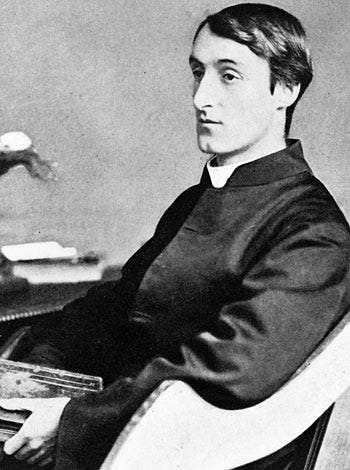
At times in his poetry, Gerard Manley Hopkins imagined a narrow, censorious Christianity which had little space for his own non-normative desires. And then, at other times, the Christianity in his poems is incarnated in a celebratory diversity which includes his own human difference. The bleaker poems resonate queasily with the current Christofascist vision of intolerance, control, and violence. But he also offers an alternative, which, in its refusal of a single form or self, seems to offer even nonbelievers a path to God.
Hopkins (1844-1889) was a middle-class English scholar who converted to Catholicism at a time when people who did so faced serious cultural and cultural stigma. He compounded his transgression by joining the Jesuits.
Hopkins’ was a serious and devout man, and his conversion had complicated motivations. One impetus, though, may have been his homosexuality. Though he would not have used that term himself, Hopkins was well-aware that he was attracted to men—acknowledging in one letter that Walt Whitman (whose poetry openly and notoriously glorified male-male love) had a mind “more like mine than any man living.” Hopkins was not pleased with the link—he called Whitman “a very great scoundrel.”
As this suggests, Hopkins’ self-recognition of queer desire was linked to self-loathing. Which suggests, in the words of Hopkins’ biographer Robert Bernard Martin, that the poet may have chosen the path of Catholic celibacy in part as an acceptable way to manage “a psychological disinclination to marriage”—since, at the time, men were not able to marry other men.
You can see Hopkins’ self-disgust in the six Terrible Sonnets he wrote towards the end of his life, when he was teaching in Dublin and struggling with illness, depression, and, he suggests, suicidal thoughts
Not, I’ll not, carrion comfort, Despair, not feast on thee;
Not untwist — slack they may be — these last strands of man
In me ór, most weary, cry I can no more. I can;
Can something, hope, wish day come, not choose not to be.
Other poems link this despair, more explicitly to his discomfort, and his church’s, with his own sexuality. In the Terrible Sonnet “Thou art indeed just, Lord,” Hopkins refers to himself as “Time’s eunuch,” trapped in his own sterility. In the 1865 sonnet, “Where art thou friend,” dedicated to Hopkins’ unrequited crush Digby Dolben, Hopkins laments that Dolben will not be with him on earth or in heaven. He’s mourning the failure in part of this world desire. But he also mourns the impossibility of an afterworld reunion, which cannot be because Hopkins’ this world desire is (in his own eyes and the eys of the Church) sinful.
Where art thou friend, whom I shall never see,
Conceiving whom I must conceive amiss?
Or sunder’d from my sight in the age that is
Or far-off promise of a time to be;
Even more telling, perhaps is “The Bugler’s First Communion”, from the late 1870s, in which Hopkins writes about a young Irish bugler coming to him for first communion. The poem celebrates the bugler’s “limber liquid youth” and “Breathing bloom of a chastity in mansex fine” before worrying that the bugler on campaign will backslide or be corrupted by lust and sexuality (“may he not rankle and ram/In backwheels though bound home?”)
In a letter to Bridges, Hopkins even said, “I am half inclined to hope that the Hero of [“The Bugler’s First Communion”] may be killed in Afghanistan.” That’s a disturbing example of the mechanics that often power misogyny, as men convince themselves to punish the object of desire, who they blame for their own lust and their own guilt.
Despair, disgust, and violence weren’t Hopkins’ only Christian response to difference, though. On the contrary, many of his most famous poems celebrate “inscape”—the inward essence of each living and non-living thing. “Glory be to God for dappled things-/for skies as couple-colored as a brinded cow,” he writes in the famous opening to “Pied Beauty,” an ecstatic celebration of heterogeneity in nature. Another example is the sonnet “As Kingfishers Catch Fire.”
As kingfishers catch fire, dragonflies draw flame;
As tumbled over rim in roundy wells
Stones ring; like each tucked string tells, each hung bell’s
Bow swung finds tongue to fling out broad its name;
Each mortal thing does one thing and the same:
Deals out that being indoors each one dwells;
Selves — goes itself; myself it speaks and spells,
Crying Whát I dó is me: for that I came.I say móre: the just man justices;
Keeps grace: thát keeps all his goings graces;
Acts in God’s eye what in God’s eye he is —
Chríst — for Christ plays in ten thousand places,
Lovely in limbs, and lovely in eyes not his
To the Father through the features of men’s faces.
The poem connects inscape in nature explicitly to inscape in human beings; stones ring and bells ring as the just man expresses justice. The individuality of each thing and person is a gift of Christ and as the presence of Christ in all things. Nor is it an accident that the triumphant conclusion is that God is visible in the “features of men’s faces”—features which for Hopkins were charged with erotic beauty as well as spiritual meaning.
In “Felix Randall”, Hopkins makes the connection between inscape, male beauty and God even more explicit. The poem is a memorial to a farrier who Hopkins comforted in his last illness. That comfort is figured as tender and borderline erotic (“My tongue had taught thee comfort, touch had quenched thy tears…”) Rather than agonizing over the fate of Randall’s soul, however—as Hopkins agonized over Dolben’s and the bugler’s—he turns back at the end of the poem to the workman’s youth, in which his inscape, physical prowess, and salvation all flare out as a triumphant sign of grace.
How far from then forethought of, all thy more boisterous years,
When thou at the random grim forge, powerful amidst peers,
Didst fettle for the great grey drayhorse his bright and battering sandal!
What is striking to me as a Jewish atheist about the Christianity in Hopkins’ poems of dappled inscapes and selves shouting “self!” is how open it is. Christian efforts to reject the narrow bigotries of Christofascism often focus on turning to Christ’s words or scripture to find statements of solidarity with the poor or immigrants or outsiders. The argument then becomes one about the truth of Christianity, with progressive Christians insisting that Christ cared for the marginalized and was not homophobic, misogynist, or bigoted.
Such arguments can be helpful in intra-Christian discussions. But they also by their nature tend to grant epistemic primacy to Christianity and Christians in the public sphere. Christofascists and progressive Christians don’t agree on what Jesus demands, but they do often (not always! But often) speak as if what Jesus demands should set bounds on public debate and policy. It is difficult to advocate against Christian supremacy while granting Christian tradition this kind of privileged position.
Hopkins seems to offer a different path. His poems generally do not start from scripture, but instead see Christ everywhere, in many different forms—in the flight of kingfishers, in the sound of stones falling in a well, in the skill of a farrier making a horseshoe.
More, Hopkins sees the divine (sometimes, it almost seems, despite himself) in places where Christian tradition has been loath to find it—in “men’s faces” as viewed specifically by other men who are drawn to them. A divinity which “plays in ten thousand places” is one which is accessible, not just through parsing the actions of one tradition or the words of one person, but via many routes. It seems to open a way (or a lot of ways) for non-Christians and Christians, straight people and not so straight people, to find God in each other.
That’s not to say that Hopkins himself would embrace this reading of his work. He could be remarkably tolerant of other views—he was, for example, a friend and admirer of Walter Pater, who was an all-but-open atheist. But as one would expect from a Jesuit, he was serious about theology, and tormented by the worry that he himself, and his sexual desires, were at odds with Church doctrines.
In “Spelt From Sibyl’s Leaves,” a late sonnet, he agonizes at the vision of a last judgement in which earth’s “dapple is at an end” and all the differences and inscapes of the world are forced into “two spools” of “black, white; right, wrong.” The variegated sparks of kingfishers and Felix Randalls at the apocalypse will be sorted and systematized; there will be good and evil, but no individuality. In theory, this is supposed to be a time of joy. But Hopkins sees it instead as a nightmare of dediversification “Where, selfwrung, selfstrung, sheathe- and shelterless, ‘ thóughts agaínst thoughts ín groans grínd.”
Like Hopkins, we’re currently faced with a choice. We can have a bleak, punitive fascist world that punishes deviation mercilessly. Or we can have a multi-cultural democracy in which difference is seen as a resource rather than a danger, and in which space and grace is granted so everyone. Which side the conflicted Hopkins would choose we can’t know. But, as with Felix Randall, we can perhaps argue that his work speaks for him, and for us.
I really enjoyed reading this. I haven’t read Hopkins since university; he’s seriously undervalued and much more accessible than many people think. I didn’t know about his life until this essay, and appreciate having that framework for considering his work. Thanks.