

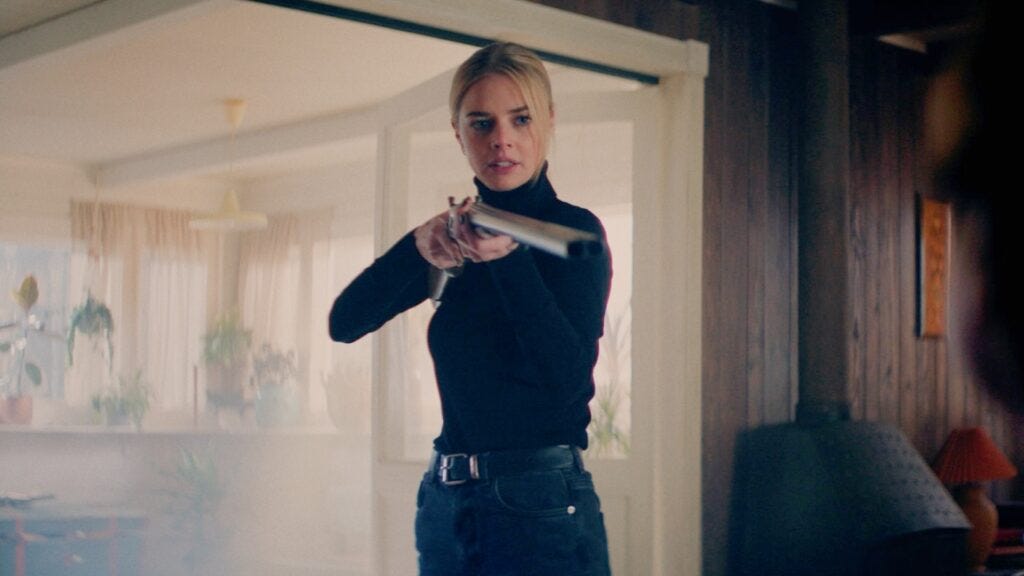
Jorma Taccone’s Over Your Dead Body seems at first like a bloody-minded divorce misery nightmare in the tradition of The War of the Roses or, the more recent Ready or Not (which also featured Samara Weaving). The film quickly abandons the vicious parable, though, for a more conventional tale of a couple brought together by adversity, criminal antagonists, and severed fingers. I’ll admit, I was a little let down that Taccone didn’t pursue the more mean-spirited and downbeat road less traveled. But the script is still gleefully brutal, and how can you resist Juliette Lewis and Timothy Olyphant at their most unhinged?
The couple who appear to be on their way to a hyperbolically brutal break-up are Dan Burton (Jason Siegel), a frustrated would-be filmmaker who scrabbles together a living directing shitty commercials, and Lisa Burton (Weaving) a not-very-successful actress. The two went into debt to finance Dan’s one failed film, and they can’t be alone for five minutes without sniping and/or screaming at each other. So they both independently decide to murder their spouse for the insurance money on a weekend retreat at Dan’s father’s cabin. But before either can pull the trigger (literally) they’re interrupted by escaped convicts Pete (Olyphant) and Todd (Keith Jardine) and their accomplish, corrections officer gone bad Allegra (Lewis.)
(Some spoilers follow, if you care about that sort of thing.)
The first part of the film is a deft exercise in weaponized himpathy. You start off following Dan as he shoots a commercial, visits his dad, prepares for his weekend; you stick with him as he drives Lisa up to the cabin and tries to cook her a nice steak dinner while she relentlessly needles and mocks him (“steak isn’t my favorite.”) Siegel’s rubbery face twists and flexes with each insult as he tries to swallow his bile and anger and be nice for just a few hours more.
You know Dan’s going to kill his wife, but he’s so sad sack charismatic you still root for him. Doesn’t she deserve it for being mean, really? And then, when she gets to tell her side of the story—how he spent all their money, how he doesn’t support her in her career, how he denigrates her acting ambitions, how he even claims her accent is from the devil—you realize that he is, in fact, as she says, a big toxic baby man, whose heart-tugging expressions of vulnerability cover over a pit of narcissism and venom. Maybe he’s the one who deserves to be murdered, after all.
The shell game with empathy and toxic masculinity could be the groundwork for a film with a nasty bite. But no sooner has Taccone taken a few steps in that direction that he backtracks—literally, with a series of Tarantinoesque flashbacks. The movie ceases to be about the dynamics between Dan and Lisa and instead becomes an escalating absurdist what-happens-next goof. The escaped criminals interrupt domestic violence with stranger danger and with their own dysfunctional relationships—Allegra is psychotically obsessed with Pete, who is sociopathically distant, while Todd shuffles along as unkillable avuncular homicidal lump. The varied tools of carnage—pool ball, flare gun, kitchen knives, lawn mowers—are picked up and discarded in ever-escalating cartoon spurts of fluid and severed bits.
Taccone is aware that he’s chosen to abandon the potentially meaningful black humor to embrace the silly. You could easily imagine a film in which, after a brief tactical truce, Dan and Lisa finish up at each other’s throats again. Instead, the film concludes with the two of them making a film version of their troubles in which they are martial arts heroes, a supposedly more farcical and Hollywood version of a story which is already quite farcical and Hollywood. Dan says at one point that he was forced to put a happy ending in his own film, though that doesn’t seem to have happened to Taccone, who is simply following the blueprint of the Norwegian film he adapted. Sometimes directors themselves just like the conventions and think those conventions are fun and funny and heartwarming—and/or they just don’t want to put the effort in to figure out another way.
Farcical and Hollywood doesn’t have to be a bad thing, and Taccone throws in enough inventively gruesome slapstick fight choreography and Lewis and Olyphant scenery chewing to make it a worthwhile 100 minutes of your time. After watching the much darker Obsession, though, it is striking how even a movie with little commitment to realism and which gets a lot of laughs from people being horrible to each other still insists that an obviously dysfunctional and violent relationship is worth saving just because it’s a relationship and this is a movie. Over Your Dead Body sounds like an ultimatum. But the film is not really willing to follow either its themes or its misanthropy through to a more uncompromising end.
“But the script is still gleefully brutal, and how can you resist Juliette Lewis and Timothy Olyphant at their most unhinged?”
How:
By not recognizing the phrase “gleefully brutal“ outside the compulsions of death squads and militaries everywhere.
Gleefully brutal probably makes sense to our current administration — open organized crime masquerading as a government.