

In a recent post on X, the fascist app, nominally progressive anti-establishment YouTuber Cenk Uygur argued that the way to defeat warmongering, and end the Israeli genocide, was to abandon partisanship in favor of antiestablishment red/brown unity.
The old dividing line was Left vs. Right,” Uygur declaimed. “And I’m sure we’ll get back to that at some point. But right now, the new dividing lines are Patriots vs. Israelis. Grassroots vs Establishment. American forces have assembled online and can’t wait to defeat the establishment and MSM.”
—
Everything Is Horrible relies entirely on reader donations. If you value this post, or my writing in general, please consider becoming paid subscribers. (Please?) It’s $50/yr, $5/month.
—
Obviously, Uygur has many financial incentives for trumpeting the virtues of online platforms over those of the MSM, and for framing his own outlet as the leader of an anti-establishment resistance which can appeal to the many, many reactionaries and fascist in the anti-establishment post-Limbaugh-talk-radio-analog media space.
But skipping over self-interest for the moment, it’s worth pointing out that Uygur’s argument here has a history behind it. There is a loud (if not large) contingent of the anti-war left which has long argued that on issues of foreign conflict, establishment Republicans and Democrats are indistinguishable, and that the only way to ensure peace is to create an alliance of isolationist right wingers and leftists.
(Nominally) left pundit Glenn Greenwald, for example, a longtime opponent of foreign wars, has often appeared with Tucker Carlson over the years to discuss their shared opposition to spending money on conflict abroad. He’s also showed up on right wing outlets to praise Trump for combating the bipartisan centrist “orthodoxy” of intervention.
Obviously, given Trump’s incessant warmongering in his second term, not to mention the ongoing nightmare in Iran, the embrace of a bipartisan antiestablishment fascist consensus for peace is looking like a mis-step. Greenwald has responded to recent developments by insisting that Trump is a liar and a fraud (he is!), and implying there was no way that he, Glenn Greenwald, perspicacious commenter, could have known that the lying fascist was a liar.
It is fun and beneficial to kick fash-curious anti-establishment entrepreneurs like Greenwald and Uygur. But the utter failure of the anti-establishment anti-war effort does raise the question—if that didn’t work, what might? The US has involved itself in a long string of ugly, ill-advised, and horrifically costly wars over the last decades, from Vietnam, to Iraq, to Afghanistan, and now into Iran. How can we stop doing that?
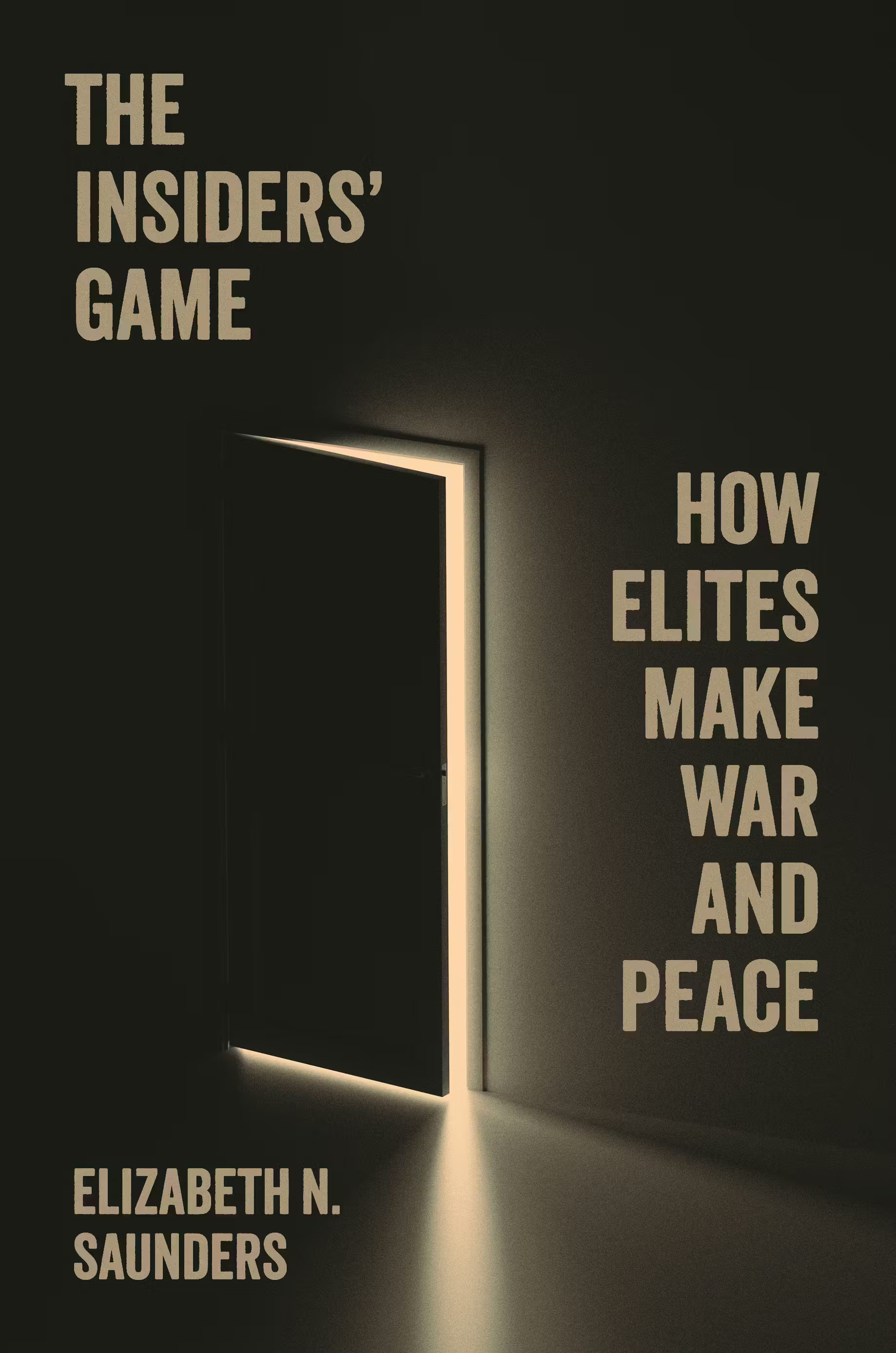
I don’t have any magic answer, unfortunately. But I think there are some useful takeaways from Elizabeth Saunders’ 2024 book, The Insiders’ Game: How Elites Make War and Peace.
An insiders’ game
Critics of US hawkish foreign policy often argue that warmongering elites form a bipartisan, uni-thinking “blob,” which demands intervention despite the popular hatred of war. In this view, the establishment is uniformly, perversely, and ideologically committed to intervention. The only hope of changing policy is to rally a populist movement against the blob—through protest, through support of an outsider candidate like Trump, or through refusing to vote altogether.
Saunders’ book challenges this view in a range of ways. She points out, first of all, that there isn’t really a populist consensus against war. Political science research has firmly established that people barely pay attention to foreign policy. “Voters are busy people, and gathering information about political issues is costly and time consuming,” Saunders notes.
Even when voters do have opinions on foreign policy issues, those issues don’t usually drive votes, because people are mostly interested first of all in issues closer to home. Trump has been damaged because his war has driven up gas prices, but absent those kinds of immediate consequences of being a losing loser who has lost, presidents rarely benefit or suffer for foreign policy choices. Obama’s approval boost after the assassination of Osama bin Laden lasted only a few weeks, Saunders notes. The 1968 election is often seen in retrospect as a referendum on Vietnam, but in fact surveys show most voters focused on other issues.
Given their disinterest in and ignorance about foreign policy, most voters very reasonably look to elites for information about when to go to war and when not to. These elites include presidents, legislators, military officials, cabinet officers, media outlets, and others.
Incentives, not blobs
Those elites are the ones often criticized as “the blob.” But Saunders argues that they do not generally operate in a blob-like fashion. Rather, in looking at a range of case studies (from Truman and Korea through Biden and Afghanistan) Saunders finds a range of intense elite debates about whether to enter wars, how to conduct them, and when to exit.
When they are contemplating war or ending wars, Presidents spend a lot of effort and a lot of political capital trying to get congressmembers, the military, and members of their own administration on the same page. They massage information available (or in the case of Johnson just outright lie), not just to the press and Congress, but to members of their own cabinet. They offer administrative appointments or photo ops or policy promises to co-opt opponents. They change strategy in order to keep hawks or doves onboard.
Nonetheless, Saunders concludes, while elites have a range of views in every conflict, hawks tend to win out. There are a range of reasons for that. One big one is that people who are more focused on military policy tend to be more hawkish, which means that the most trusted experts tend to be more likely to advocate for escalation.
It also means that it is easier to placate doves by offering them other trade-offs or policy incentives. Saunders points out that the conventional wisdom that Lyndon Johnson chose the war over his Great Society is false. On the contrary, Johnson believed he needed to continue with the war in order to keep hawkish Southern Democrats on board since he wanted them to vote for his domestic program. Doves were less likely to turn against Johnson on the war since they prioritized domestic issues, and so he largely ignored their antiwar viewpoints.
Johnson’s choices in this case were typical of Democratic conundrums when facing choices around war. Democrats have traditionally been (and are still) the more dovish party. Unfortunately, that means they are seen as weak and untrustworthy on defense issues by much of the electorate.
They are also hobbled by the fact that they actually have a domestic agenda. They therefore have powerful incentives to compromise on war to get some right wing/hawkish support, in order to dilute opposition to the domestic agenda that they often see as more important.
The result is what Saunders refers to as the “dove’s curse”—Democrats tend to get “trapped in…inconclusive military conflict[s]” because they don’t want to escalate but also don’t want to pay the political price of pulling out, which may damage their reputation with elites and so sink their agenda. The dove’s curse is what kept Johnson in Vietnam, though he knew the US could not win. It’s what kept Obama in Afghanistan, though he never really wanted to be there.
Biden and the possibilities of polarization
There’s one clear exception to the dove’s curse in Saunders’ book—Joe Biden. Biden promised in the 2020 campaign that he would end US involvement in Afghanistan. And so he did, despite a barrage of negative press and a major public approval hit. More, as Saunders points out, he went on “to a string of domestic legislative successes—including the Inflation Reduction Act of 2022 and significant action on the Democratic priority of addressing climate change.”
Saunders argues that Biden’s dovish policy was enabled by greater partisan polarization. Polarization means that there is little Democrats can do to get Republicans on board; they will be criticized no matter what they do. As a result, there is much less incentive to consider GOP views.
Biden, notably, did not include any Republicans in his cabinet—a significant change from Obama, who kept Robert Gates on at Secretary of Defense and then had to navigate Gates’ hawkish views on Afghanistan. Because he didn’t include hawks in his inner circle, he faced little internal pushback when Afghanistan’s government collapsed immediately after US withdrawal. Because he knew Republicans were going to vote against his proposals anyway, he didn’t bother trying to adjust his Afghanistan policy to please GOP Senators or Congresspeople. And because Democrats have strong incentives to support a Democrat in a polarized age, Biden didn’t worry about losing hawks in his own party either. “Polarization may give dovish leaders and dovish elites more room to be their dovish selves,” Saunders concludes.
Biden’s refusal to end weapons shipments or sanction Israel as it committed a genocide in Gaza (rightly) infuriated and horrified the left, and people may be loathe to look to him for cues going forward. But I think Afghanistan, and Saunders’ analysis of it, offers a possible path forward for those of us who would like the US to stop pointlessly bombing people.
Doves need cover for being doves, and they need assurances that being doves won’t sink the rest of their domestic agenda—which tends to be the agenda they care the most about. In that context, flirting with red/brown crossover, and elaborately signaling that you are willing to work with fascists as long as they agree with you on some minimal foreign policy, is unlikely to be persuasive. Democrats will just see you (rightly in my view) as untrustworthy and immoral. For Democrats, dovish foreign policy is going to have to be congruent with domestic goals such as voting rights and the social safety net. Allying with someone like Tucker Carlson, who hates both those things, is a non-starter (and should be.)
More, in a highly polarized environment, with one party pretty clearly doves and the other pretty clearly hawks, it makes no sense for doves to support the hawkish party—with votes, rhetorically, or in any other way. Trump’s vaguely dovish noises were always transparent lies, and the lies were transparent in no small part because he was the leader of a hawkish party, and appointed hawkish figures who did hawkish stuff and boated about war crimes. If foreign policy is an insiders’ game, then institutional affiliations and personnel choices are more important than the random blustering of one individual lying fascist. You should evaluate candidate accordingly.
Evaluating candidates in the last election were somewhat confused because Israel policy has been the one area which, up to now, has been bipartisan rather than polarized. Biden himself is an ideologically committed Zionist, and he cosigned a horrific war and genocide in a way he almost certainly would not have done if Israel had been any other country.
But even on Israel, the ground is shifting. Last month on a motion brought by Vermont leftist Senator Bernie Sanders, 40 Democratic Senators voted to condition aid to Israel versus only 7 who voted for no restrictions. In contrast, every Republican Senator voted for no restrictions—drawing a stark line between the parties. Democrats overwhelmingly want to restrain Israel; the GOP does not.
A year ago, Sanders got only a smattering of Democratic support; now he is in the majority in his caucus. There’s no secret as to what caused the change—Democratic voters have been horrified by the Gaza genocide, and have turned sharply against Israel. More, anti-Zionist candidates like New York Mayor Zohran Mamdani and New Jersey House Rep Analilia Mejia have won primaries and general elections. That has translated into a change in elite consensus—and to greater polarization on the issue.
Maybe a game not just for insiders
Saunders worries that greater polarization has some dangers. Presidents may not be able to get bipartisan support in times of crisis, which could limit their ability to act. And as we’ve seen in Iran (which occurred after Saunder’ book was published) a president entirely in a partisan bubble, like Trump, may have fewer constraints and no checks when he wanders orangely off to war and atrocity.
But I think one benefit of polarization which Saunders does not consider is that it creates conditions for more public input. Again, foreign policy decisions are mostly made by elites. But activists and voters can elect different elites and affect elite views. Or at least, they can do that when issues are polarized, because when issues are polarized, there are clear partisan differences between candidates, and clear partisan signals on issues.
One of the reasons that Vietnam was not a major issue in 1968 was because Nixon and Humphrey had much the same stay-the-course platform on the war. Similarly, despite the claims of various factions in the Democratic party, Gaza was not a major issue in the 2024 election in large part because neither Harris nor Trump promised a major break with Biden. But if Israel policy gets more polarized, then voters will be able to cast a ballot either for elites who offer endless support for war, or for elites who offer not that.
As Saunders says, elites and experts are always going to have an outsize role in decisions about war and peace. The public is always going to be mostly disinterested and ill-informed. But people—and, crucially, issue activists and issue organizations—can have a lot more say when the parties take distinct stances. Contrary to the vaporous self-puffery of Cenk Uygur, public input for peace is going to be greater, and more effective, if we do not pretend that left and right are the same.
Democrats have always been vaguely more doveish than Republicans. Thanks to a great deal of activism and effort, Democrats today, though, almost look like actual doves, rather than dove-like simulacra. I think if we want more peace and less war, we should acknowledge that there is a real difference between the parties, and act accordingly.
I am one of the minority who has always been interested in foreign policy. Maybe because I came of age during the Vietnam era, or maybe because I understand that the U.S. is part of an international community. I am so furious that USAID was dismantled and that this administration has ruined our NATO relationship.
Cenk and TYT have always been fash curious.