

The Predator franchise is steeped in reverse colonial tropes. The first film features an outer space invader falling upon and hunting a group of American mercenaries engaged in colonial special ops that reference (and clean up) America’s various dirty Latin American interventions. It’s an updated War of the Worlds, where the fun is in fantasizing them doing to us what we’ve done to them—which justifies us doing it to them, only harder.
—
Everything Is Horrible is entirely reader funded. If you find my writing valuable, please consider becoming a paid subscriber. It’s $5/mo, $50/yr.
The Predator sequels were largely uninspired rejiggerings of that conceit—until director Dan Trachtenberg and screenwriter Patrick Aison picked up the series. Their 2022 installment, Prey, reversed the reverse colonialism by having a Predator battle a Comanche woman in 1719 on the Great Plains. The colonizer is in this case standing in the place of actual colonizers and you are meant to root for actual colonized people—a twist which was a popular success and also managed to irritate all the right fashy assholes.
After an animated outing in Predator: Killer of Killers, Trachtenberg’s live-action follow up— Predator: Badlands—continues to scramble colonial tropes, though not as daringly as in Prey. Nonetheless, the film is an illustration of what you can do with hoary narratives if you’re willing to trust your audience to identify with people who aren’t quite the usual heroes.
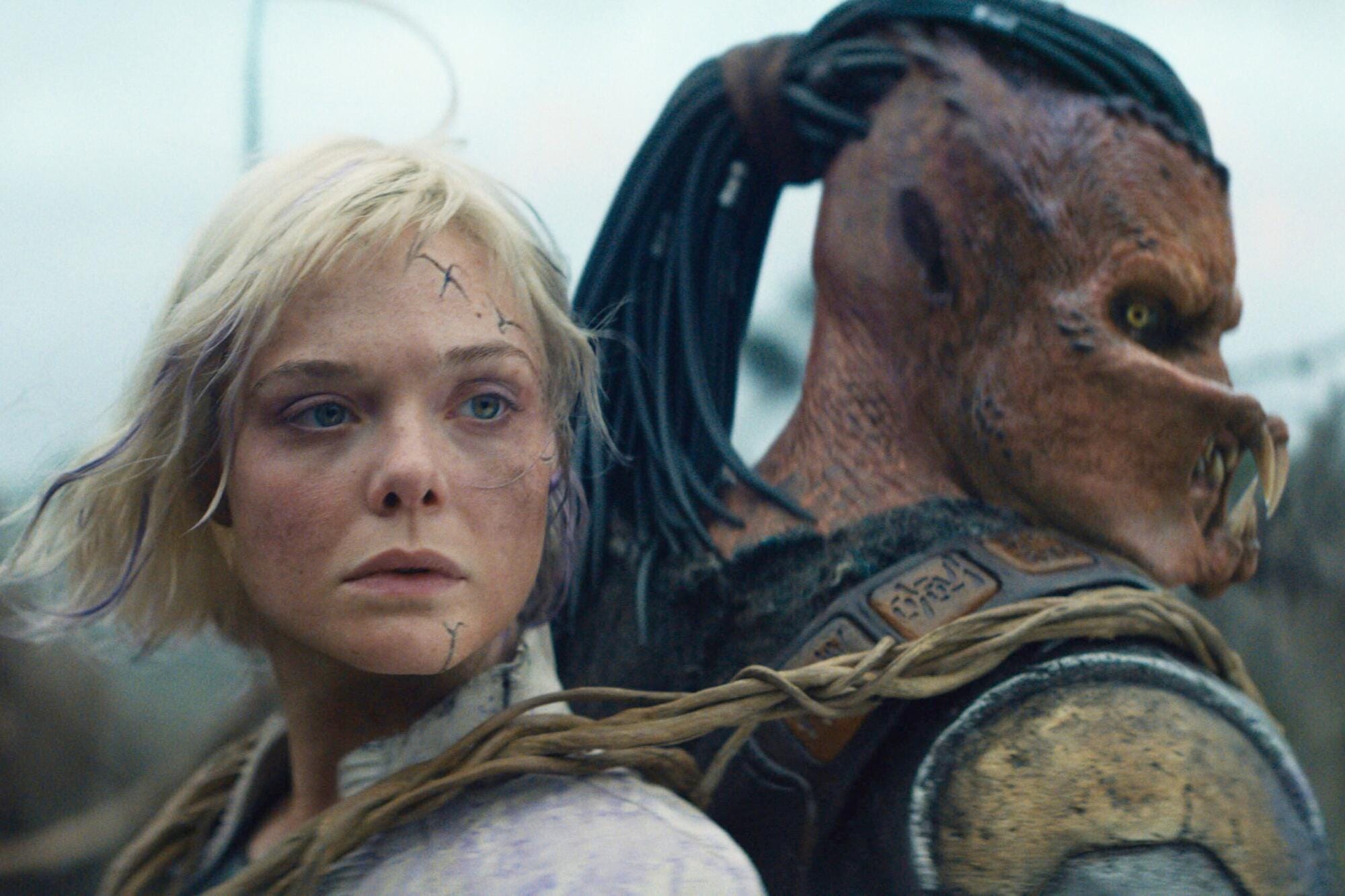
The not-usual hero you’re asked to identify with primarily here is Dek (Dimitrius Schuster-Koloamatangi), an unusually short Yautja (which is what the Predators call themselves). The Yautja generally murder undersized members of the clan, but Dek’s brother Kwei (Mike Homik) protects him from their father Njohrr (Reuben de Jong).
Kwei dies in the process, but his last wish is for Dek to prove himself by going to the planet Genna to hunt and kill the dreaded Kalisk. On Genna, Dek meets and reluctantly joins forces with a legless android, Thia (Elle Fanning), who is part of an expedition to collect biological specimens for the Weyland-Yutani Corporation (of the Alien franchise).
Schuster-Koloamatangi is a New Zealand actor of Samoan and Tongan heritage, and as in Prey, the choice to star an indigenousperformers in a story about a violent colonial endeavor is no doubt intentional. Dek isn’t one of the colonized though; he’s essentially a big game hunter and/or an adventurer in (supposedly) uncivilized territory. The narrative, as a narrative, is not so different from the Avatar films; there are bad colonizers (the Corporation) which wants to exploit the native life, and then there are good colonizers (Dek, and eventually Thia) who initially embrace exploitation, but who eventually “go native”, learning the ways of the land and allying with indigenous people—in this case a vaguely monkey-like creature who Thia names Bud, and who claims Dek as family by spitting on him.
The basic themes and story beats here are, then, pretty stock. But you can do stock better or worse, and Trachtenberg has figured out some clever ways to do it better. Avatar is cloying and clichéd because it wants to do Dances With Wolves but in space as straightforwardly and cleanly as possible. Trachtenberg, in contrast, wants to mess up the white savior dynamics—both by providing lots of gross and glorpy special effects (plants that distend grossly and shoot knock out needles; slugs spitting acid, big hunks of grotesque meat) and by using alien camouflage to distract from the smooth progress of a familiar story. The cowboy hero has a face full of fangs and speaks a guttural dialect; the indigenous people are regenerating dragons; cathartic victory is signaled not by cross-racial hetero joining, but by a queer-coded found family.
There are limits as to how far Trachtenberg—or Disney—is willing to go with scrambling their old stories. Thia’s passionate wish to find her colleague robot Tessa (also Fanning) initially reads as romantic, but the script soon rushes to assure us that Thia sees Tessa as sister, not lover. Similarly, the potentially subversive meanings of casting a non-white lead, which are fully explored in Prey, are muted here by the fact that Schuster-Koloamatangi’s face is obscured by CGI through the entire film. The Murderbot novels, as just one example, are a lot more willing to challenge not just the appearance and background of their heroes, but also their actual narrative expectations and positions. There’s a big difference between cheering for a failed colonizer to self-actualize and cheering for an enslaved person to break their chains.
Badlands, in that sense, does seem like a retreat from Prey. Still, on its own terms, it is a hoot. Even if you can see the usual hero in outline under those flexing fangs, it’s still fun to watch this monster hit that monster with a legless robot tied to its back. The taciturn hero who has to learn to work with others is a lot more fun to watch when the emotional truths are communicated through growls and grunts and globs of saliva. Fanning, as the only actors who gets to use her own face mugs and chatters for all she’s worth—and then handles the icy villain duties with aplomb as well. Add in some really inventive CGI fight choreography involving (among other things) severed legs, and it seems a bit churlish to ask for more.
Prey is probably the best pulp franchise sequel of the last 20 years, and one of the few that outdid the first film in the series by confronting and questioning its core assumptions and logic. If you were expecting more of that, the sequel is a little disappointing. If, in contrast, you are just looking for an enjoyably imaginative SF adventure romp, Predator:Badlands delivers.
As an homage to the passing of Robert Duvall, I busted out my old dvd copy of Apocalypse Now: Redux and managed to make it to the Col Kilgore scenes before realizing it was waaayyy past my bedtime. Anyway, after reading your piece, it got me thinking about how the colonized/colonizer tropes apply to Coppola’s film. On the surface they don’t seem to translate, that there is something more fundamental at work. What’s your take?