

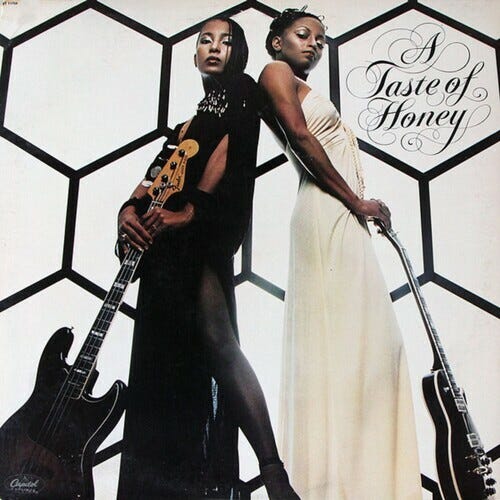
Some years back, I would talk regularly on social media with Dee, a music critic and historian who ran the amazing Black Rock Tumblr. Dee often argued that Black musicians who made rock music were habitually pushed off into other genre designations—R&B, soul, blues. Rock was seen as central, important, and white; other genres were seen as more Black and (therefore) less important.
The Black Rock Tumblr is no longer active, and I’ve lost touch with Dee. But I’ve thought and written about her points a lot over the years. I recently realized that I haven’t ever explained how rock is defined by whiteness, and why that matters, all in one place. So I thought I would do that, somewhat belatedly here.
--
Everything Is Horrible relies entirely on contributions from readers. Please consider becoming a paid subscriber; it’s $5/month or $50/year.
or you can tip me on paypal or venmo
--
US popular music genres have long been defined by race
In casual discussions of pop music, people often act, and speak, as if those music genres are defined by formal elements. You can tell a country song because it’s about rural America and uses fiddles. You can identify a metal song because it’s tight and loud and the vocalists scream or growl. New Wave music has guitars and synthesizers. And so on.
But historically (and not just historically) this just isn’t true. Or as scholar Nicholas Stoia writes:
Beginning in the early 1920s, and continuing through the mid 1940s, record companies separated vernacular music of the American South into two categories, divided along racial lines: the “race” series, aimed at a black audience, and the “hillbilly” series, aimed at a white audience. These series were the precursors to the also racially separated Rhythm & Blues and Country & Western charts, and arguably the source of the frequent racial divisions of today’s recording industry.
Race records and hillbilly records were not separated by style. They were separated by intended audience and by the skin color of the performers.
Stoia further points out that “early blues and country music exhibit thorough interpenetration.”
What he means by that is that early blues and country performers listened to each other, were influenced by each other, and sounded a whole lot like each other. They were not formally distinct. In fact, they were so interchangeable that record labels sometimes mislabeled them. The Allen Brothers, a white duo, had a record released in Columbia’s race records series.
The Allen Brothers were enraged and threatened a lawsuit—which underlines that the genre distinctions were not just a separate but equal marketing categories. The Allen Brothers were very obviously influenced by Black artists; they very obviously listened to and learned from Black artists. Black people probably bought their music. But Black people were stigmatized. The Allen Brothers were racist and did not want to be associated with that stigma.
“Hillbilly” and “race” records, then, were not primarily ways to signal formal differences. The genre markers were a way to assure white people they were listening to white people and didn’t accidentally listen to Black people (like Mississippi John Hurt) by mistake.
Even more importantly, though, genres were a way to allow white performers to avoid being mistaken for Black when they played music from an interracial tradition. Hillbilly music was defined by whiteness as a way to maintain segregation and buttress white supremacy.
The music itself was not racialized or segregated; white and Black performers freely and frequently listened to each other, traded ideas, and even recorded with each other on occasion—as when white guitarist Eddie Lang took the name “Blind Willie Dunn”, pretending to be Black on a (stunning) Lonnie Johnson track.
But the actual practice and the actual sound of music was neither here nor there. The marketing and categorization of the music was, and was intended to be, racist.
“Rock” is racist too
The same dynamics that shaped hillbilly and race records have also shaped the categorization and reception of rock music.
Like popular music in the 20s, rock has always been an interracial music, powerfully influenced by both white and Black performers and styles. The performers that most famously epitomized rock music as it transitioned from rock and roll—the Beatles, Bob Dylan, the Rolling Stones—were inspired by artists like Black electric bluesman Howlin’ Wolf, Black acoustic bluesman Blind Willie McTell, Black girl groups like the Shirelles, Black rock and roll guitarist Chuck Berry, Black genius Ray Charles, white rockabilly stars Carl Perkins and Elvis Presley, white folk musician Woody Guthrie, white country artist Buck Owens, and many more.
All those other artists also had white and Black roots—Chuck Berry’s “Maybellene” was based on the western swing tune “Ida Red” as just one example.
In short, there was not a stylistic firewall between white and Black music in the 50 and 60s. There was often, though, a genre and marketing split—which is why Howlin’ Wolf was blues (despite being influenced strongly by white country artist Jimmy Rodgers) while Elvis Presley had a new genre, rockabilly, coined to describe him (despite being influenced by a slew of Black artists).
This dynamic—formal integration matched with genre segregation—continued with rock. Performers like white rock singer Janis Joplin had access to a larger audience and a more central cultural position when she belted out blues vocals; Big Mama Thornton (who wrote Joplin’s hit “Ball and Chain”) was still considered a blues artist and relegated to the festival circuit. The Beatles absorbed Black and white influences, embraced technological innovations, and became rock stars. They still are often cited as the greatest band of all time. Sly and the Family Stone absorbed Black and white influences (and had Black and white members) embraced technological innovations, and became soul, funk, R&B stars. They’re mostly treated as a footnote; virtually no one (but me!) argues that they are the greatest band of all time.
The dynamic is especially stark in the case of Jimi Hendrix. Hendrix is often pointed to today as evidence of rock’s interracial bona-fides. But at the time, he was greeted by many white critics as an interloper in psychedelic rock, and his appeal to white audiences was framed as a crass betrayal. Black blues guitarists were supposed to stay in their niche. Hendrix refused, and for his trouble racist white rock critic Robert Christgau called him an “Uncle Tom”. White racist critic Albert Goldman in an article about Hendrix titled with the racist slur “Superspade Takes Atlanta” sneered at Hendrix for “playing to almost exclusively white audiences” and “consorting with white women” and insisted that “Hendrix’s blackness is only skin deep.” (All cited in Jack Hamilton’s Just Around Midnight.)
These white rock critics believed that they were protecting the purity of the blues and of Black music by putting Hendrix in his place. But of course these kind of racist slurs were not deployed against the Rolling Stones when they played blues for white audiences and consorted with white women. When white people arrogated to themselves the right to decide what music was Black, and which musicians were Black, they were really just enforcing segregated genre boundaries, and, not coincidentally, protecting the rock income stream for white artists.
New Wave, same racism
The racist abuse directed at Hendrix has largely been memory-holed; Robert Christgau is still celebrated and cited. He has never apologized for his disgraceful racist attack on one of the most important Black artists in popular music, and no one seems to remember or care about his bullshit.
But the dynamic persists. You can sometimes see it more clearly in subgenres. For instance, New Wave is a genre defined in part by time period and in part by formal markers—it’s generally thought of as rock music from the early 70s through the 80s that incorporates synthesizers and new technology.
It’s also, though, powerfully defined by whiteness. For instance, Elvis Costello often tops lists of best New Wave albums. But Elvis Costello was a traditional singer/songwriter whose jangly pop rock is more often than not synthesizer free.
In contrast, Janet Jackson is inevitably discussed as an R&B artist, even though the brutal synth rhythms of “Nasty” would be considered innovative genius if they came out of Devo or Talking Heads.
The fact is that Janet Jackson, Marvin Gaye, Prince, Stevie Wonder, Grandmaster Flash, ESG, Nona Hendryx, Herbie Hancock, Run-DMC and many others were all part of a biracial wave of experimentation with new technologies. The fact that critics only saw synthesizers as innovation when they were deployed by white bands that didn’t necessarily prevent Black people from earning money. But it did create a critical consensus about who should top lists—and about whose music was forward-looking new, exciting. At the time, it seemed obvious that Elvis Costello was the future and Janet Jackson was a staid mainstream which the white guy was bravely fighting. That’s the same racism that made Christgau want to eject Hendrix from rock.
The logic holds in many contexts. What’s the difference between fusion and prog other than the supposed race of the performers?
Why isn’t Kelis indie rock?
If Timbaland was white, wouldn’t he be post-rock right there with Sigur Ros?
It’s not that you can never identify formal elements of genres. It’s that the lines are always blurry and multiple, and one of the ways they’re drawn is so that the Beatles treacly schmaltz “Long and Winding Road is rock, while Betty Davis is soul, funk, R&B—some other non-rock thing.
What does it matter?
Again, many Black musicians make a good living, are widely respected, and have integrated audiences. Why should we care that they aren’t recognized as rock? And isn’t it even insulting to suggest that Ray Charles or Beyoncé need to be “rock” to be influential or important?
I hope that this discussion has illustrated some of the reasons it matters. But it’s worth reiterating. Ray Charles doesn’t need this label or that label to matter and neither does Beyoncé; they are both incredibly popular geniuses. But genres nevertheless shape how music is received, where it can be received, who gets accolades, and who gets money.
Black musicians like Jimi Hendrix shouldn’t be deluged with racist bullshit when they play with or for white audiences. Black musicians shouldn’t be told they can’t perform at white rock clubs—and yes, I have heard Black musicians talk about being turned away from venues when they showed up and were not white, even today in the progressive era of Donald Trump. Black performers shouldn’t be treated as irrelevant to innovation or to new styles that they helped pioneer. White musicians influenced by Black music shouldn’t be thought of as cool while Black musicians influenced by white musicians are deemed sell-outs.
The truth is that segregating music and defining certain styles by race, while it may enrich some white people, is in general not good for any musician who has an interest in making art. White performers, too, sometimes have racist politics leveraged against them. Sometimes this can manifest as charges of appropriation. Sometimes it can look like white supremacists attacking Elvis for singing music they associated with Black people.
And sometimes it can be weird, as when Robert Christgau for in a 1976 review of an ABBA album sneered that, “their disinclination to sing like Negroes reassures the Europopuli.” As I wrote in an essay a while back:
That “Negroes” is meant as an insider sneer; Christgau is parodying the European distaste for Black people, supposedly. The actual effect, though, is to cosign the idea that Black people sing, and should sing, a certain way. Moreover, ABBA is as influenced by disco as Eric Clapton is by blues. Why is one unconscionably white while the other gets praised as “honest”? Who is Christgau to rule on what’s really Black, anyway?
Defining rock by whiteness is also bad because it encourages us to define our culture and our country by whiteness. The idea that there is some singular formal difference between music by white people and music by Black people, and the idea that the music by white people is more central and more important, has obvious implications in Trump’s America. When innovators in music are always white, when the most important music is always white, then it makes sense to see Black people in all walks of life as less innovative, less creative, less smart, less important. Black people can perhaps be helpers or provide useful life lessons for white people, as the Rolling Stones got useful lessons from Howlin Wolf. But the main story is the way those Black people inspired white men to new heights of awesome creativity and success.
That doesn’t have to be, and shouldn’t be, the story of music or the story of this country. Recognizing that Big Mama Thornton, or Janet Jackson, or Beyoncé, are central to rock music forces us to recognize that Black people are central to US culture and to US history. It forces us to recognize the ways that our lives are intertwined, and to recognize the deliberate tactics used to prevent us from seeing that.
Rock is just a convenient cultural category. But so is race. Genres, labels, and categories are arbitrary impositions, but those arbitrary impositions have a huge effect on the way people see, listen to, and interact with the world and on the way the world sees, listens to, and affects them. Obviously just getting rid of genre labels on music would not set us all free. But if we stopped defining genres by whiteness, we’d be a little less racist, and maybe able to hear our music, and our country, a little more clearly.
Very true of disco, too. It didn't become mainstream until the Bee Gees' Saturday Night Fever became a blockbuster. Barry Gibb talked about the racism factor in a documentary about the band.
Separately, Janet Jackson's Rhythm Nation is one of my all time favorite albums. Should be up there among the greatest of all time.
Rock is not just White. It's White Male.