
The Polarization Discourse Is Bad Faith Bullshit
Let us count the ways.

In its racist decision to gut the Voting Rights Act, the Supreme Court babbled a bit about polarization. Jake Grumbach at Slate argues, on that basis, that the polarization obsession of many centrists provided cover for the decision. Political scientist Jonathan Bernstein, in contrast, believes that the right has been trying to destroy the VRA for decades, and that they didn’t need permission from asshole centrists like Ezra Klein, nor from anyone else.
I tend to agree with Bernstein here, for what it’s worth. But I was also interested in another point her raised: why are centrist assholes like NYT columnist Ezra Klein so obsessed with polarization? Faced with a rabid and rapidly radicalizing fascist movement, why do so many people rush to insist that the problem is that some people dislike fascism too much?
Bernstein offers a couple of explanations:
… focusing on polarization has two big advantages for many people. One is that it avoids placing responsibility on any single set of political actors, which is inevitable if one studies Republican dysfunction and Republican attacks on democracy. Plenty of people, for a variety of reasons, don’t want to do that.
The other advantage of centering polarization is that addressing the real problems with US democracy requires support for two very unpopular institutions – Congress and the parties. That goes against the grain of US political culture.
I think those are persuasive arguments. But I also think it’s worth examining why “plenty of people…don’t want to” place responsibility on certain political actors—which I think is another way of saying that plenty of people do not want to name fascist political actors as fascist when they see them. Or, to put it another way, why are people like Ezra Klein—who supposedly oppose fascism—so determined to lie about and normalize the actual fascist political program of Charlie Kirk?
I think, as Bernstein says, there are a range of reasons. I want to explore a few of them in turn.
—
Everything Is Horrible is entirely funded by readers. If you find my writing valuable, please (please?) consider becoming a paid subscriber. It’s $50/yr, $5/month.
Political pragmatism
In a conversation with journalist Ta-Nehisi Coates, Klein himself argued that he had obscured and lied about Charlie Kirk’s hatefulness because he admired Charlie Kirk’s political successes (“Charlie Kirk…was a successful political actor”) and because he believes that somehow kowtowing to Kirk and his audience should enable Democrats to win in red states (“Sherrod Brown should be able to win in Ohio.”)
This is the reactionary centrist electability argument. You must not name Republicans or their policies as the problem because if you do you will lose. Instead, you must empathize with and center Republican voters, adopt their policy positions, and reap the electoral bonanza. Treating fascists as fascists will lead to losing to fascists, a la FDR and Winston Churchill. Instead, you must appease fascists and achieve assured victory, a la Neville Chamberlain.
As you probably noticed, however, the real life Neville Chamberlain is not generally considered a model for successful opposition to fascism. Nor has reactionary centrism as a policy suite been very successful. As I’ve written a time or two, we have some examples of reactionary centrism in practice in the careers of Kyrsten Sinema, John Fetterman, Jared Golden, and Labour UK. In every case, the effort to appease fascists through rebranding and reactionary policy has led to massive alienation of co-partisan without corresponding enthusiasm from fascists, who still prefer their fascist party to bigoted bilge from wobbly appeasers.
These failures are not particularly obscure—Labour’s self-immolation on the pier of half-assed fascism has been particularly vivid and egregious. More, Democratic electoral fortunes since 2024 have experienced a wild reversal, not because they’ve adopted reactionary centrism en masse, but simply because they are not Donald Trump. If anything, the party has moved left (on, for example, Israel) as it has grown more popular.
Given all that, it is hard for me to credit reactionary centrists with good faith when they claim that they have a magic electoral cheat code in appeasement. Ezra Klein, in his discussion with Coates, does seem to be speaking from a place of genuine despair—illustrating, perhaps, why Catholics believe despair is a sin. But often when reactionary centrists say that we should eschew polarization and embrace a little fascism to win electoral victories, I think they are obscuring other motives.
Anti-polarization masks a preference for fascist policies
Of those motives, the most straightforward is that the reactionary centrists themselves personally believe in, approve of, or want to push particular fascist policies. They denounce polarization because they would like to see certain fascist policies (attacks on immigrants, for example) receive bipartisan support. They do not want to name fascism as fascism because they themselves are (at least on some issues) fascists.
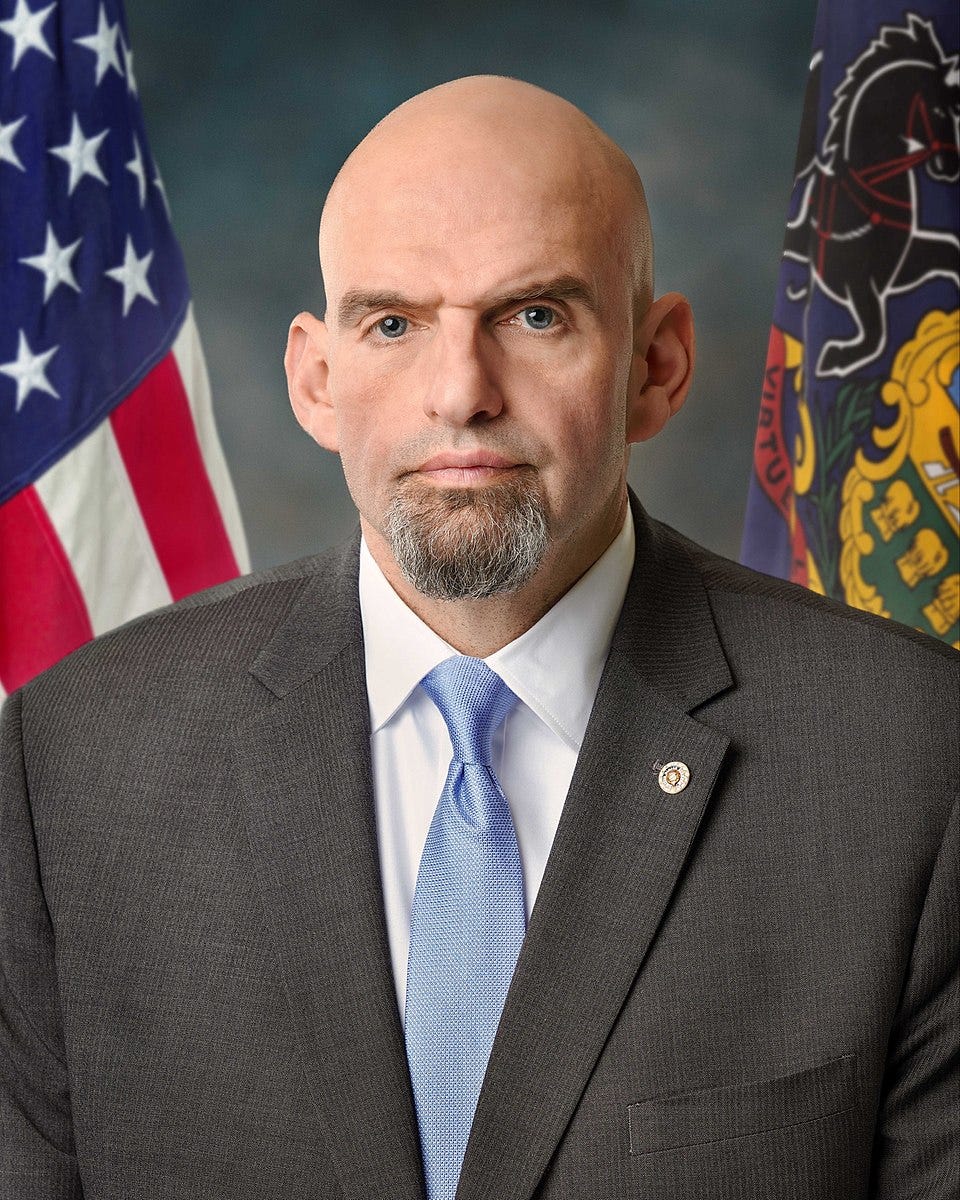
One good example here is Pennsylvania Senator John Fetterman. Fetterman ran in 2022 as a progressive and a loyal Democrat. He aired harsh negative partisan ads against his opponent and promising to be a reliable vote in the Senate.
Somewhere along the line, though, Fetterman underwent a radical change of heart. Today he is the rightmost Democrat in the Senate. He often votes against his parties priorities, and regularly kowtows to Trump. He has even endorsed Trump’s extremely unpopular, and obviously corrupt, White House ballroom project.
Many Democrats have argued that Fetterman’s stroke late in his 2022 campaign led him to veer right. But I think a more convincing explanation is that Fetterman was pushed right by Israel policy.
Fetterman has always been a Zionist, and he, like many others, was horrified by the Hamas attacks and murder on 10/7. As Israel’s violent response escalated and the scale of the genocide in Gaza became apparent, some Democrats slowly—like longtime Zionist Illinois Senator Dick Durbin—began to distance themselves from the right-wing Netanyahu government. Fetterman, though—who has always been a very stubborn man—doubled, then tripled, then quadrupled down. Faced with left criticism of his indifference to Palestinian suffering, he insisted he was “not a progressive”. He also began to highlight other right-leaning policy positions, especially on immigration.
Fetterman has also become (not coincidentally!) a strong critic of polarization, repeatedly insisting that Democrats are victims of “Trump Derangement Syndrome”—that is, he thinks Democratic hatred of Trump is illegitimate and irrational partisan polarization.
This criticism of polarization serves to rationalize Fetterman’s own embrace of Trump and Netanyahu’s genocidal policies. Fetteran wants to talk about polarization rather than fascism because he wants the fascists to win on at least some key policy points. In decrying partisanship, he is specifically decrying partisanship against fascism, because he likes fascism and believes that people should stop opposing it in key areas.
Anti-polarization masks the use of fascism to crush opposition
Sometimes people embrace fascism on policy ground. But people can also embrace fascism more instrumentally, as a way to suppress challengers or rivals for power within or between institutions.
One example here which I’ve discussed before is The New York Times’ instrumentalization of trans hate. I do believe that the owners and editors of the Times are sincere bigots and want to force trans people out of public life. But they have also used their trans hate to discipline and crush their own workers.
In 2020, during the George Floyd uprising, the Times ran a racist editorial from Senator Tom Cotton advocating the use of the military against protestors. Times staffers, led by Black workers, revolted, forcing an apology and the resignation of opinion editor James Bennett.
Backed by a powerful civil rights movement and widespread public revolt against racism, the multi-racial laborers at the Time essentially seized the means of production for a moment, forcing editorial and staffing concessions. Editor A.G. Sulzberger was not pleased.
Sulzberger bided his time, and in 2022, the national right wing anti-trans moral panic gave him his chance. The Times devoted thousands and then tens of thousands of words to attacking trans health care and to laundering biased right wing talking points intended to drive trans people out of public life.
Again, workers at the paper objected, and 1000 former and current contributors signed a letter in protest. But, as I wrote a couple years back:
This time, though, there was not a nationwide civil rights protest buttressing the staffers. On the contrary, there was a national embrace of bigotry, which the NYT was stoking and riding. Editors at the paper felt comfortable ignoring criticism and crushing dissent.
Instead of focusing on the specific criticisms of coverage, management claimed that staffers who had signed the letter had violated newsroom standards. They held private meetings threatening signatories with reprisals if they engaged in similar protest in the future.
The newsroom standards that were supposedly violated were, of course, ones involving objectivity and neutrality. Attacking trans people with bigoted and shoddy talking points is objective reporting; demanding better is partisan polarization. “The New York Times doesn’t exist just to tell progressives how progressives should view reality,” a bitter James Bennett fulminated—by which he meant that the New York Times should exist to kick progressives and put them in their place.
Anti-polarization boilerplate here does serve to advance the Times’ fascist hatred of trans people. But it also functions as a way to discipline unruly labor, reasserting the control of capital and the rule of white male bosses over Black and trans workers. Fascism is, among other things, a tool of violent backlash, which can be used to crush challenges to established hierarchies.
Attacking polarization becomes, in this context, a way to obscure and even reverse power relationships by insisting that objections to violent fascist hierarchies are violent social disorders. Or, as Martin Luther King said, the New York Times editorial exemplifies “the white moderate, who is more devoted to ‘order’ than to justice; who prefers a negative peace which is the absence of tension to a positive peace which is the presence of justice.” Polarization here is the lack of order. Fascism is the negative peace of oppression and death.
Anti-polarization preserves relationships threatened by antifascism
In addition to policy and power, anti polarization discourse is also a tool for preserving community—specifically for preserving fascist, or incipient fascist, community.
Again, John Fetterman is a good example. In an interview with the Pennsylvania senator, Politico’s Dasha Burns pointed out that Trump had called Fetterman “the most sensible Democrat,” and wondered if that was likely to hurt him with Democratic voters.
Fetterman responded, “My parents would appreciate it. I know and I love a lot of people that voted for Trump, and that’s part of why I refuse to call these people Nazis or say they’re brown shirts or they’re trying to destroy our democracy.”
This is straightforward. Fetterman’s family support Trump, so he doesn’t want to talk about fascism. Instead, he wants to talk about polarization. The problem is not that his parents support fascism; the problem is that people point out that his parents support fascism. By pointing to polarization, Fetterman can set himself against those who criticize his parents, rather than setting himself against his parents.
Trump is very unpopular. But he nonetheless still has millions of supporters. Many people have Trump supporters who they love, or who they see as part of their community. They do not want to see those people as fascists; they do not want to think about what it means that those they love or care for have embraced violent racism and hate. So they argue the problem is polarization, because then they can attribute moral fault to those they don’t care about (often non-white people) rather than to the (often white) people they love.
It’s all white supremacy
There are, then, a range of reasons that people focus on polarization rather than fascism. But there is a single throughline connecting them.
That throughline is white supremacy. People emphasize polarization over fascism because they find some fascist policies appealing. They emphasize polarization over fascism because they believe fascism will help them gain or hold power. They emphasize polarization over fascism because they are in community with and feel solidarity for fascists. In each case, polarization is useful because it deflects from and minimizes the moral responsibility of fascists and white supremacists, and smears those who criticize fascists and white supremacists.
Fascism has a broad constituency in the US. Most fascists are in the fascist party. But even to those who are not part of that party, fascism can appeal. To some it offers policies they approve of, from Zionism to trans hate. To some it offers the opportunity to shore up their institutional power. To some it offers community with fascists. To many it offers more than one of those things.
Whatever fascism offers, though, it is important to realize that it is fascism which is offering it. The discourse about polarization is a deliberate attempt to obscure that. When people talk about the evils of polarization, they are deliberately normalizing fascism, and demonizing critics of fascism. They are insisting that hatred and hierarchy and authoritarianism are good, and that the real problem is with people who say they are bad.
There are those like Trump who are willing to defend fascism positively, on the merits, and boast that they are white supremacists. But there are others who recognize that white supremacy and bigotry sound bad but still want to indulge in them around the edges, as a treat. Anti-polarization discourse is designed for the second group. They want to be able to hate and still tell themselves they are good people.
That is bad faith bullshit, and we should say so. Polarization against fascism is good. It is, in fact, as Julia Azari said in our interview last week, “the most hopeful thing.” If we are going to defeat fascism, we need more polarization, because more polarization means more people willing to call evil what it is, and to do something about it.
I coach high school Constitution Team, and occasionally we get questions about "polarization". This piece encapsulates exactly what I teach the kids. I've had pushback from judges and other coaches on all these points, and it frustrates me to no frickin end.
Now that the current political situation is looking analogous to that of pre Civil War, and we live in Portland OR, and apparently many judges and coaches read Heather Cox Richardson, I've noticed way fewer challenges to these arguments.
I take comfort that at least some people find it awkward to blame the Civil War on the abolitionists.
This all comes back to the idea of the banality of evil. By all accounts, everyday Germans who supported Hitler were "nice" people, all of whom chose to look the other way when people were getting rounded up and sent to death camps. Fetterman is illustrating the same principle, i.e. if my family voted for Trump, they are not Nazis. It's pathetic and disgusting.