

This piece was written on commission. If you want to commission a film, today is the day! Just get an annual paid subscription today at 40% off, $30/year. Caveat is that has to be a film I haven’t reviewed and which is available on streaming. Just write the film in the notes when you subscribe.
Alternately! You can commission me for $30 on venmo or paypal; links below. (Again, make sure you let me know in the message what film you want, and leave an email so I can contact you.
John Landis’ 1996 The Supidsis supposedly about a family of stupid suburbanites. It isn’t really, though. Instead, it’s about a family of suburban conspiracy theorists. The disconnect there renders the film largely inert. It doesn’t know what it’s about and doesn’t want to know what it’s about. As a result, it ends up spinning in nervous circles trying to avoid the implications of its own pallid gags.
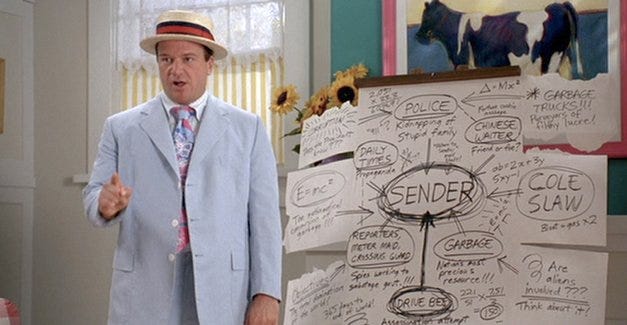
The sort-of plot involves the Stupid family who are stupid (get it?) Suburban patriarch Stanley Stupid (Tom Arnold) believes that someone is stealing their garbage when they leave it on the stoop; he sets out to track down the culprit. His kids then think he’s disappeared; they leave a poorly written note which causes their mom Joan (Jessica Lundy) to think they’ve been kidnapped by the police.
That’s the way it goes throughout the movie. Sometimes the Stupids are stupid because they miss the obvious or fail to make obvious connections—as when a gas attendant tells Stanley that he’s got a hole in his gas tank and he replies that he knows because that’s where you put the gas in. But these vaudeville moments are by the way. The main driver of the plot is a different kind of stupid—a stupid where the Stupids construct elaborate conspiratorial explanations to explain why the garbage is being taken from their front lawn, or what happens to letters marked return to sender.
The Stupids, in other words, are conspiracy theorists. The thing about conspiracy theorists, though, is that they’re not stupid. Often, on the contrary, conspiracy theorists are too smart for their own good. They put a ton of thought and effort and even genius into researching and cogitating about their theories. But the theories are built on poor assumptions or just wrong information. Anti-vaxxers know a ton about vaccines and can engage in long, abstruse, complicated discussions about them. Their brains work fine; they just work on the wrong things.
Conspiracy theories can be funny because they’re so divorced from reality. But they’re not funny the way it’s funny to mistake the meaning of a hole in the gas tank. They’re funny in a more nervous, bleaker way, because passionately losing touch with reality can lead to real violence and real cruelty. If you think that nice museum curator is a threat to the world and only you know, what will you do to him? Now, more than ever, when we’re ruled by conspiracy theorists, it’s clear that this is not an idle question.
It’s not a question The Stupids wants to have anything to do with, though. Hatching elaborate plots to identify and track down enemies of the people is treated as equivalent to forgetting your car keys. The joke is “look how stupid they are” over and over. They made a mistake, ha ha.
The best moments in the film, not coincidentally, are when the movie toys with the idea that the Stupids aren’t just harmless dopes, but maybe possibly are something a little darker. Stanley disguises himself as a bush and becomes drunk with the potential power of being a man-bush; his son Buster (Bug Hall) thinks he’s traveled back in time to the prehistoric age and writes his name on the wall boasting about how he’ll be the most famous and mysterious person in history. Those gags flirt with the way conspiracy theories and megalomania are one and the same; to think you are the one true knower is a desperate and often menacing empowerment fantasy.
In that vein, the real highlight of the movie is a sort-of fantasy sequence where Christopher Lee as a devilish supervillain explains his evil scheme for stealing garbage and destroying mail using killer bees. Or something like that; the details matter less than Christopher Lee swaggering around and cackling while tossing invitations into the fire and exclaiming, “I guess no one will go to that wedding!”
Lee is funny and ridiculous and flamboyant. But he’s also Christopher Lee, which means that even with the funny ridiculous flamboyance there’s an undertone of actual menace and actual meanness. He wants to ruin weddings; he wants to prevent lovers from meeting. His elaborate plots make no sense, but that doesn’t mean they just effervesce. The nonsense is twisted into a hook with a barb.
Landis doesn’t want his main characters to have that kind of barb. But he’s made them conspiracy theorists. The only way to resolve the contradiction is to drain them of all individuality. The Stupids are all blandly, happily airheaded, with no individual quirks or interests. They don’t argue or even really have discussions not because they’re stupid, but because they have no personalities.
A movie determined to avoid thinking about its own topic, themes, and characters is not going to be a good movie—not even a good funny movie, not even a good stupid movie. Landis wanted to make a light distraction but stumbled into material with some weight. Watching him back away from what he’s done for 90 minutes is a tedious exercise.
Now I’m wracking my brain to figure out what movie to commission- it has to be something I liked but wouldn’t be too bummed if it’s ripped to shreds.
Hmm, commission a review, ey? Hmmnnn…