


Zionists sometimes flat out deny that Israel is committing genocide or war crimes. That argument has become less and less tenable as Israel’s grotesque body count has mounted in its latest round of wars and atrocities.
So Zionists sometimes fall back on another argument. Yes, they say, Israel may have committed some excesses. And yes, maybe, technically, an apartheid state which openly grants those of a certain religion and ethnicity more rights than others is bad. But don’t lots of states embrace ethnonationalism and genocide? Why does the American left focus on Israel rather than on Saudi Arabia or Iran or China? If you care about one ethnonationalist genocide, you should care about all ethnonationalist genocides equally. Ergo, if you’re social media feed doesn’t spend as much time denouncing Mynamar as you spend denouncing Israel, then you must be antisemitic. QED.
This argument is not really deployed in good faith, and cannot therefore be refuted in good faith. But I think it’s worth thinking about the underlying issue. Israel does loom large in US discourse, on all parts of the political spectrum.. But the solution is not to refuse to discuss Israeli crimes. The solution is to disentangle American identity—and not coincidentally American military and diplomatic resources—from the political program, crimes, and identity of a genocidal ethnostate.
—
Everything Is Horrible is supported entirely by your donations. If you value my writing, please consider becoming a paid subscriber. It’s $5/month, $50/year.
Bad Faith
Again, it’s worth emphasizing that whataboutism in this instance is simply not in good faith. If you actually believed that ethnonationalism was wrong, you would not respond to criticism of an ethnonationalist state by saying, “Well everyone is doing it.” If you think genocide is evil and must be stopped, you do not argue that all genocides must end simultaneously or else criticism of one genocide is illegitimate.
It’s pretty easy to see the bad faith if you look at, say, advocacy for Ukraine. People who are trying to get the US to direct more resources to prevent Putin’s horrors in Ukraine do not say, “You should stop talking about Israeli war crimes and talk about Putin’s war crimes instead.” Nor do they say, “Talking about Israel’s war crimes instead of Putin’s war crimes is antisemitic and illegitimate.” Instead, they argue something like, “Putin’s invasion of Ukraine is an ugly imperialist fascist colonial power grab much like Israel’s actions in the Middle East; we should consistently oppose fascist genocide everywhere.”
If you actually care about Ukraine (and you should!) you argue that people should focus on Ukraine more, not that they should focus on Israel less. If you believe that we should not be funding Saudi Arabia (we shouldn’t!) you say, “We shouldn’t fund any antidemocratic dictatorial regime”. You don’t say, “Well, if we’re funding Saudi Arabia, we should fund Israel too.”
Zionists who deploy whataboutism don’t care about the injustices they are whatabouting. They are not committed to helping the people of Ukraine or of Saudi Arabia. They are committed to deflecting criticism of Israel. This is why when you say, “Yes, we should give more aid to Ukraine and none to Saudi Arabia”, they mostly shrug or insist that you’re a hypocrite. They do not want the US to have better policies across the board; they approve of America’s cynical and ugly support for dictatorships (from Putin to the Saudis) because that support shores up the status quo support of Zionism.
This is why opposition to Zionism is in fact opposition to colonial and fascist foreign policy everywhere. Zionism creates powerful incentives and constituencies for colonial and fascist policies. It is vital to oppose Putin and the Saudis. But opposing Zionism is a necessary part of doing so, because Zionism and the worst aspects of American policy and identity are intertwined.
The US offers a staggering amount of support to Israel
There are ideological reasons for the importance of Zionism in US foreign policy. But before getting to those, I want to underline that US support for Israel, over time, is in fact orders of magnitude more sweeping and more substantial than our support for basically any other country or regime.
In 2024, Israel received $6.82 billion in aid from the US, just beating out Ukraine at $6.51 billion. The third largest recipient was $1.74 billion to Jordan—a country which we prioritize in part because of its relationship with Israel.
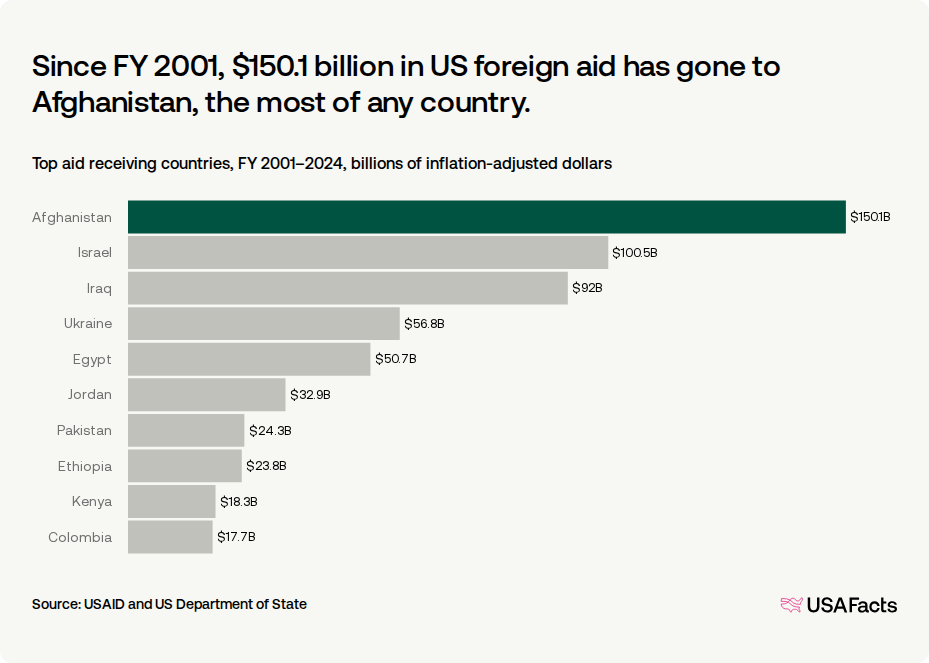
US aid commitment to Israel is not a one year thing. Since 2001, Israel has received $100.5 billion in aid—second only to the $150.1 billion to Afghanistan, a country in which we were fighting an actual war.
Go back further and Israel’s share of aid balloons. Since 1946, the US has given Israel $244 billion in military aid. That is vastly more than the amount given to Egypt in second place at $83 billion—and again, aid to Egypt has been in part meant to shore up Israel’s position and power in the Middle East. The amount given to Israel is more than the total military aid given to Afghanistan and South Vietnam, the countries in which the US had the longest sustained wars of the period. (Israel received the second most non military aid at $86 billion, narrowly outpaced by India at $87 billion.)
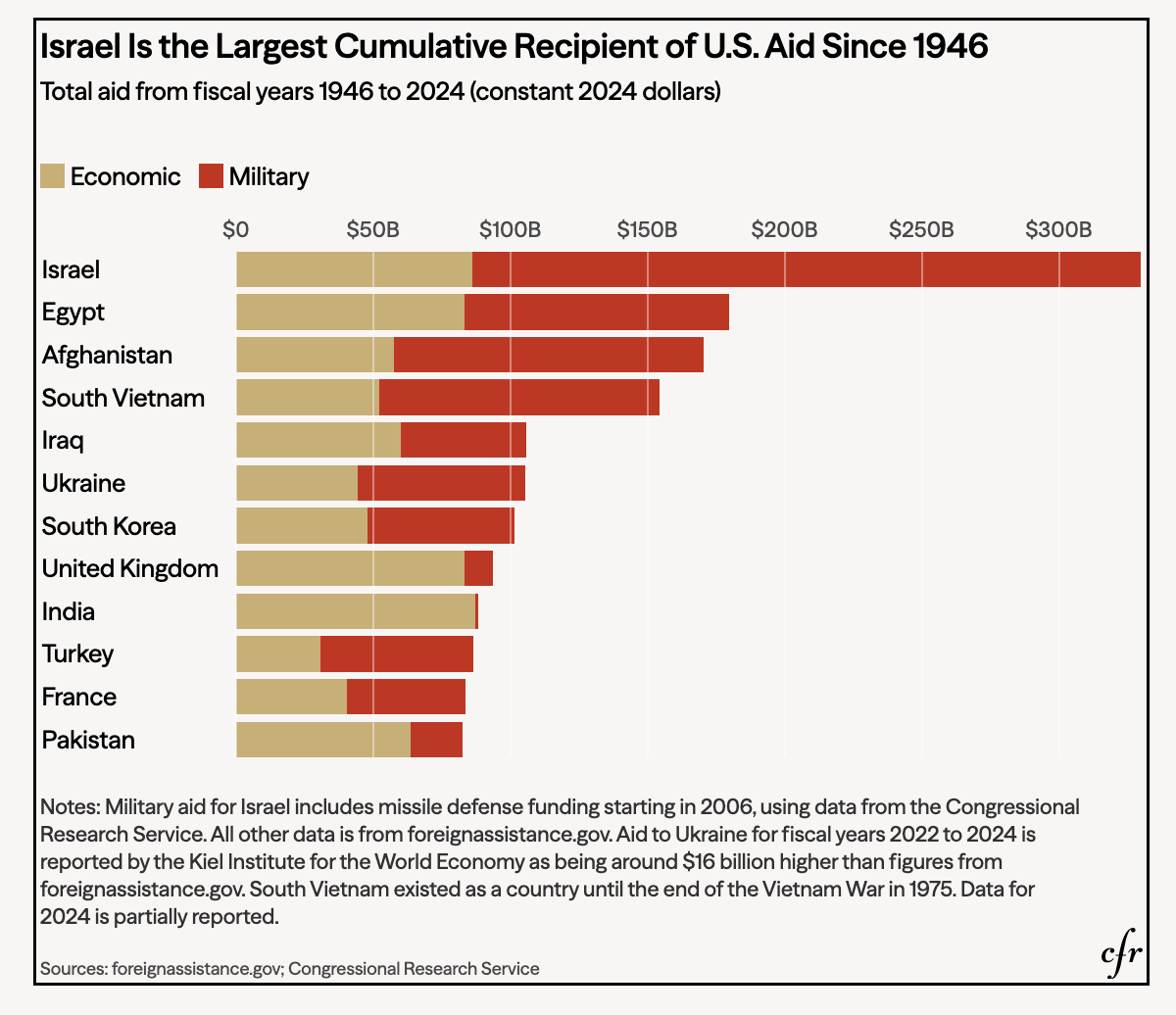
These figures are stark. US military commitment to Israel outsrips its military commitment to any other country in the post-war period. The US should absolutely stop selling weapons to (for example) Saudi Arabia, which has used those munitions to exacerbate horrific human rights abuses in Yemen. But, in the first place, these weapons sales are sales, not aid. And in the second the scale of military support over time is simply nowhere near what the US provides to Israel. And that’s even before you get into the US incessantly providing diplomatic cover by blocking Security Council resolutions designed to reign in Israel or censure it. And it’s also not taking into account the fact that the US and Israel just this year launched an illegal war of aggression jointly against Iran at a cost (so far) of around $40 billion.
Americans are closely focused on Israel’s warmongering because Israel’s foreign policy is uniquely backed and subsidized by US aid and diplomatic power. No other country in the world has received as much US military aid as Israel. That means that the US is uniquely complicit in Israel’s actions, and it means that Americans have a moral duty to advocate against military aid to Israel when that aid is being used to commit a genocide.
Israel is central to American identity
The focus on Israel (by all parts of the political spectrum) is in part a reaction to the enormous American financial and military investment in Israel. But it’s also true that the financial and military investment in Israel is caused by American interest in and focus on Israel.
Many Americans feel intensely connected to Israel. This is the case, obviously, for many Jewish-Americans. Jewish-American institutions are very Zionist, and many (not all! but many) Jews are committed to Israel, which they see as righteous reparations for the Holocaust, as a necessary refuge from the antisemitism of the rest of the world, and/or as a way to create a strong, virile ethnonationalist Jewish identity in contrast to the weak, alienated stereotypically Jewish limpness of the diaspora.
Jewish people only make up about 2.3% of the US population, though, and (contrary to antisemitic propaganda) we (for better or worse) control neither the media nor the weather. America’s unique investment in Israel is something that American Jews can contribute to, leverage, negotiate, and/or try to survive. But it isn’t primarily driven by American Jews.
Instead, Zionism in the US is driven mostly by gentiles. There are several strands of this support; the most discussed is Christian Zionism. Many evangelical Christians believe that the land of Israel was given to the Jewish people in the Bible, and so support for Israel is viewed as a religious duty. This is sometimes connected to millenarian beliefs that the end times will occur once all Jews have gathered in Israel, ushering in the second coming. More recently, evangelical Christian hatred of Muslims has powered support for Israel’s exterminationist and genocidal policies.
This evangelical Christian support for Israel is extremely powerful and consequential, especially in Republican politics. Christians United for Israel, a Christian Zionist organization, is by far the largest Zionist organization in the US with more than 10 million members. Evangelical Christian Zionists—like ambassador to Israel Mike Huckabee, Defense Secretary Pete Hegseth, and former South Carolina Senator Lindsey Graham—have held key positions from which they have influenced and driven Israel policy.
Christian Zionists are not the only gentile Zionists, though. In addition to this kind of religious Zionism, there is also a secular, liberal Zionism. Liberal Christians like former president Joe Biden and former representative Haley Stevens do not believe that Israel is Biblically ordained. But they do believe that Israel is a moral liberal necessity. To quote my recent discussion:
This is why President Joe Biden—a longtime Zionist, who disgracefully facilitated Israel’s genocide in Gaza—talks about Israel not only as a security ally, but as a moral calling. “You don’t have to be a Jew to be a Zionist,” Biden said in 2024, “and a Zionist is about whether or not Israel is a safe haven for Jews because of their history of how they’ve been persecuted.” Similarly, former Michigan Senate candidate Haley Stevens in 2023 declared, “America is a place for the Jewish people….Israel comes to me in my dreams, I see Israel’s future and I know that Israel will continue.”
For Biden, Stevens, and many others, the Jewish people have been uniquely persecuted throughout history. The United States therefore showed itself uniquely virtuous and liberal by defeating Hitler and liberating the camps. America’s hold on virtue is secured by its historical role in freeing and sheltering Jewish people. To fight for Israel is, from this perspective, to fight for the best in America. The billions in aid to Israel is in part a pragmatic investment in securing influence in a crucial (oil-rich) region. But it’s also an investment in American values and goodness; America pays Israel to validate and secure its own liberal self-regard and its right to rule the world virtuously.
The overlap of these ideological currents—liberal American, Christian American, Jewish-American—has created a powerful bipartisan American identification with Israel, and a powerful bipartisan Zionism. For many Americans historically, and still today, to be Zionist has been part of being American.
This was not a dual loyalty (for either Jews or non-Jews) but a conviction that American identity meant support for Israel—that Zionism was the truest American patriotism, because Israel represented the truest part of America, whether Christian or liberal. When behind closed doors in December 2023, weeks into the genocide, Biden said, “We’re not going to do a damn thing other than protect Israel in the process,” he was expressing his core belief that liberal virtue and Zionism were continuous. Israel’s war crimes and genocide were regrettable, but they were a small price to pay for the patriotic liberal sacrament of Zionism.
Contesting Zionism is contesting a certain vision of America
American foreign policy, and American identity, have been built on military support for Israel for decades. That means that Israel is not just another country committing bad actions among many. It is a country in which America is uniquely invested, and a country which, Americans are told, we should especially reverence.
Israel’s example, and Israel’s defense, are cited as a rationale and a blueprint for broader Middle East policy, from the invasion of Iraq to the bombing of Iran. Israel’s experiences are used to justify Islamophobic policies and attacks in the US. Its defense rationalizes attacks on freedom of speech, including silencing professors, sending police to crack the heads of student protestors, and fascist takeover of legacy media. Through its training of US police, Israel provides know-how for disciplining dissidence and subjugating minority populations in the US.
Protestors in the US focus on Israel not because of antisemitism, but because Zionism has become a core part of illiberal ideology in the US—not least because it has sway with many who consider themselves liberal in other respects. Zionism offers a fascist ethnonationalism that feels liberal; it offers a liberalism that is racist, violently colonialist, Islamophobic, and intolerant of dissent. That creates an extraordinarily dangerous fascist/liberal coalition. It is vital for liberals and leftists of goodwill to reject that—and yes, Zionism’s unique position in American life means that it is going to generate, and require, more pushback than authoritarianism in Myanmar or Saudi Arabia (though we should condemn US support for or indifference to violence in those countries as well!)
Antizionism and Jewish identity
As a last, personal observation, I think it’s important to note that Jewish antizionists have powerful reasons to speak against Israel.
Many Jews (including me) see opposition to Israel as a core part of our Jewish identity. “Never again,” for many of us, means never again for anybody. It is a particular, personal betrayal to see Israel embracing the ethnonationalist ideologies and the genocidal violence that have in the past been unleased against Jews in the diaspora. It is horrific to watch Netanyahu bolster and propagandize for a fascist antisemitic American regime which hates and is attempting to exterminate immigrants—a group which has historically included, and been conflated with, Jews.
In addition, American Jews can’t help but notice that our identities and our safety are constantly used by Zionists (Jewish and non-Jewish) as a justification for hideous fascist action, in the US and abroad. It is in my name, supposedly, that the IDF murders Palestinian journalists; it is my name, supposedly, that my friends and colleagues in the US are attacked by police, ejected from their jobs, and blacklisted. When fascists say that they are murdering people in your name, to protect you, personally, as a Jew, many of us who are Jews feel like we have a responsibility to speak out.
This is in part because it is the right thing to do. But it’s also an act of self-preservation. It is not safe to find yourself in the mouths of fascists for any reason. If fascists want to use you, and you do not allow yourself to be used, or you cease being useful, you will often be the next target. Trump has repeatedly said that Jewish people who don’t vote for him are “disloyal.” Zionists—Jewish and non-Jewish—cheerfully refer to antizionist Jews as “kapos” or traitors.
The main victims of Zionist violence and hatred are Palestinians and Muslims. But antizionist Jews are also targeted, and may be targeted further if we don’t speak up. Solidarity with Palestinians is vital because Palestinians are being attacked in horrific ways and they deserve our support. But solidarity with Palestinians it’s also necessary for antizionist Jews because solidarity with Palestinians is essential if we are going to show solidarity with ourselves.
The fact that Americans devote attention to Israeli crimes is often framed by Zionists as unfair and antisemitic. But this inevitably means that the criticisms of Israel from antizionist Jews are also framed as illegitimate, even though (again) those criticisms are based in Jewish ethics, Jewish history, and a very Jewish recognition of shared oppression and shared threat. To tell Jewish antizionists that they cannot speak to Israel unless they also talk about Saudi Arabia, or Mynamar, or what have you, is telling Jewish antizionists that they have no right to speak as Jews or from their Jewish identity. That’s antisemitic.
Similarly, to tell American antizionists, Jewish or non-Jewish, that their focus on Israel is illegitimate is to tell them that they cannot criticize core American policy and ideology. But it’s also to tell them that they are not allowed to stand in solidarity with Palestinians, with Muslims, and with American antizionist Jews. That’s not taking a stand against antisemitism. It’s taking a stand for fascism, for silence, and for genocide.
This is just an outstanding piece.
The blowback from certain liberals to Ta-Nehisi Coates over his position on Israel/Gaza was revealing. How could you have appreciated anything he’d written or believed previously and be shocked or somehow disappointed to his consistent position on ethnonationalism and brutal violence? There is also a racist core to the argument that innocent Palestinians can be targeted and die because of Hamas (and it’s ultimately Hamas’s fault) when Americans would balk at that being applied to white supremacist terrorism. Hell, we have more freedom to remove Trump — but we don’t — so would that justify Canada killing U.S. children?