

—
Everything Is Horrible is entirely supported by readers. If you find this essay valuable, please consider becoming a subscriber so I can write more such. It is $50/yr, $5/month. You can also tip me at paypal.
—
In 1707, Mt. Fuji erupted for one of the last times in recorded history. The great Japanese artist Hokusai (1760-1849) included his own fanciful vision of the event in his first volume of 100 Views of Mount Fuji, published in 1834.
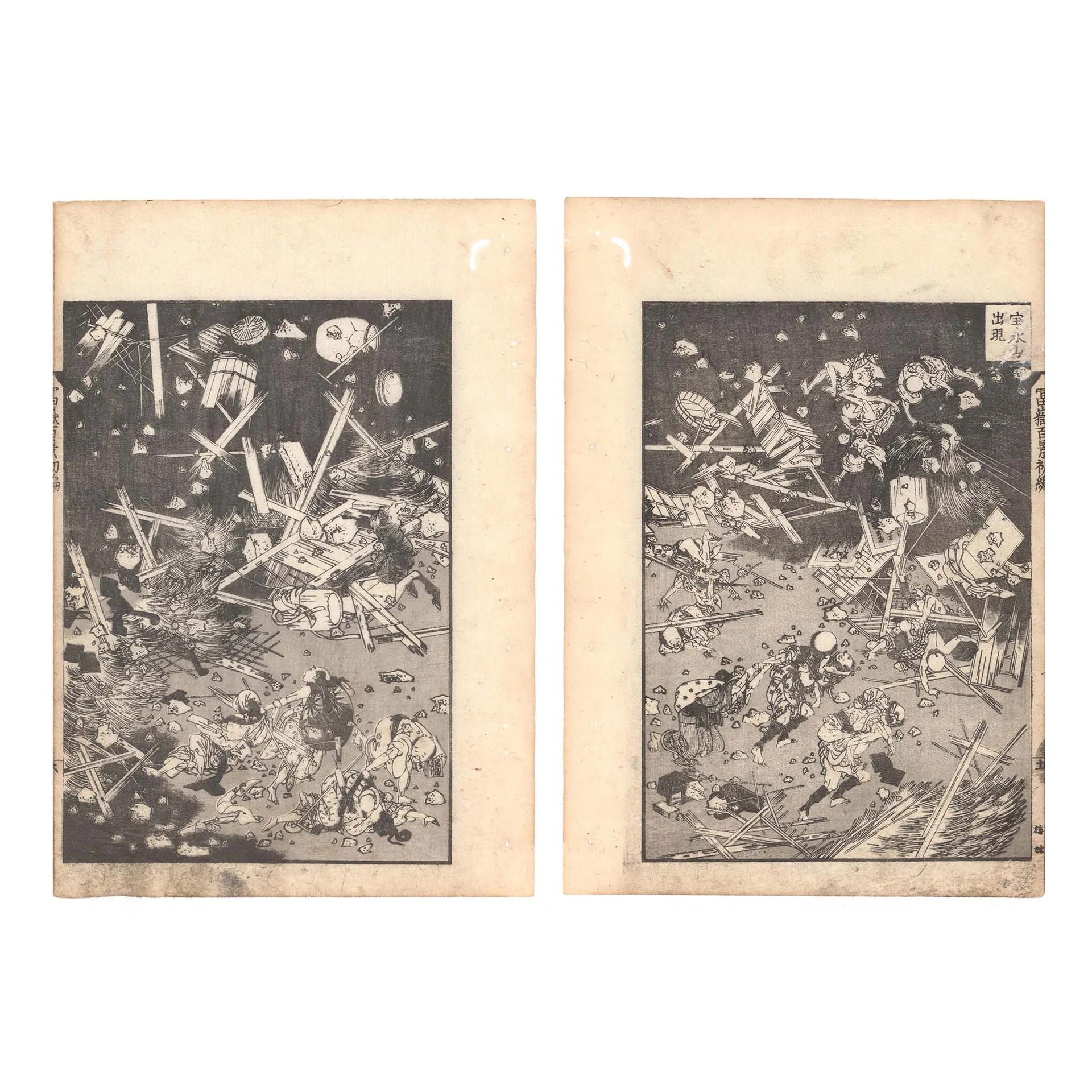
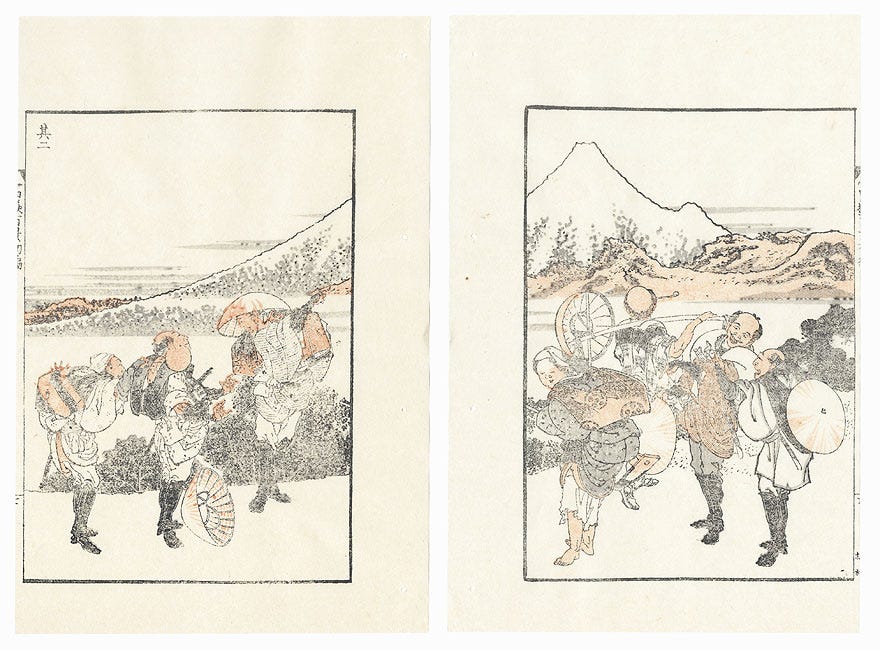
That image of chaos is (rightfully!) famous. Slightly less well known is the subsequent illustration, which shows the results of the blast. The eruption occurred not through the top of the mountain, but through the side, leaving a crater (called Hoeizan) behind. In all his drawings of the mountain, Hokusai never depicted this blemish—except once.
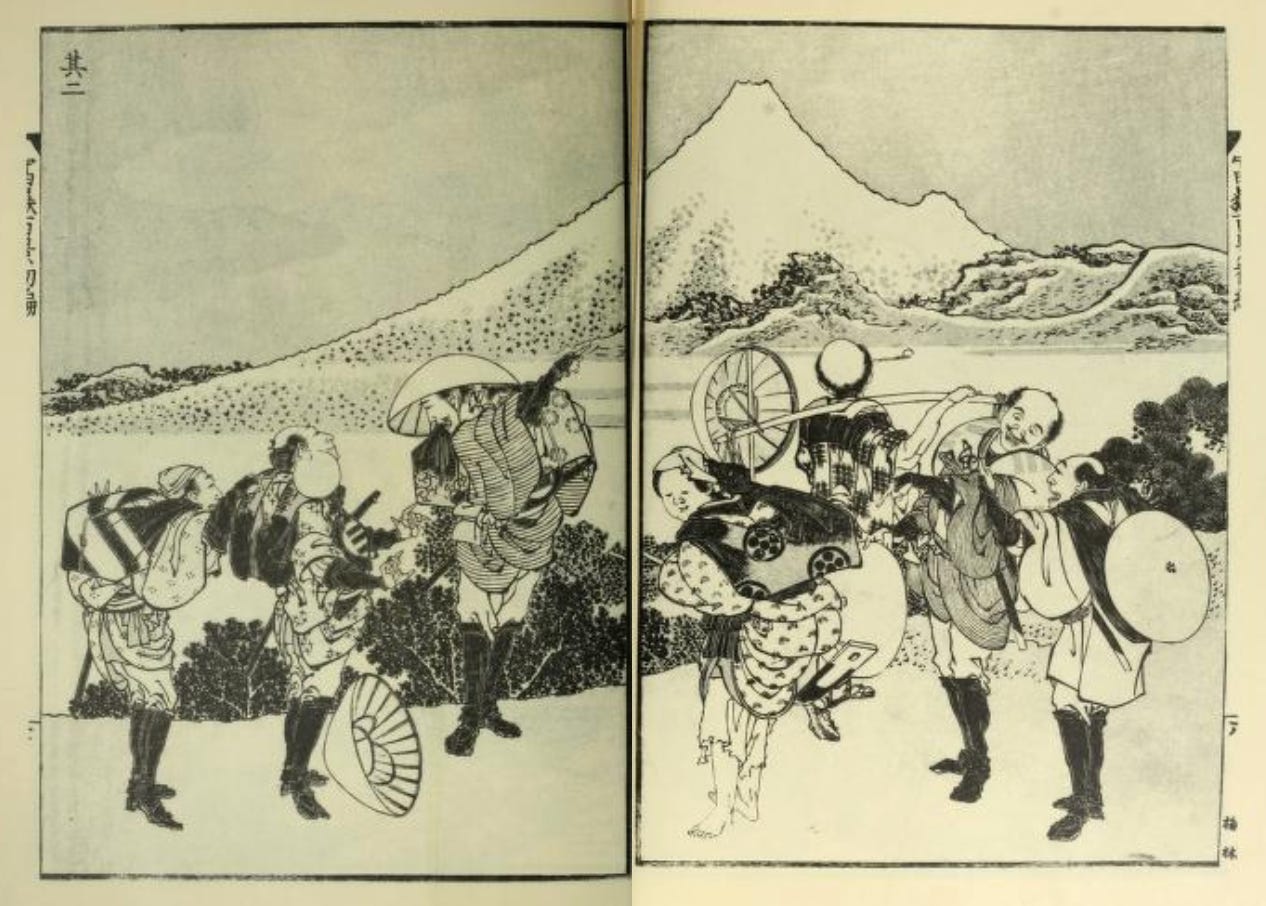
In the background, you see the familiar sweep of the mountain and its characteristic rough peak. But you also see, off to the side, the hump of Hoeizan, forming a kind of doubled head.
As often in the foreground of his images, Hokusai here depicts a group of people—in this case travelers chatting and joking. In particular, they appear to be laughing at one man on the lefthand page who suffers from a facial disfigurement; he has a massive growth obscuring his cheek and neck.
In his monograph Disability Aesthetics, critic Tobin Siebers argues that the depiction of disability (mental and physical) is central to the aesthetics of modern art. Perfect form and perfect health has for the last 150 years or so been perceived as kitsch. Portrayals of disability and imperfection, in contrast, are seen in modern art as a sign of individual and realistic vision.
For example, consider how Toulouse-Lautrec—who was disabled himself, and who was hugely influenced by Japanese prints—handles disability in his famous At The Moulin Rouge.
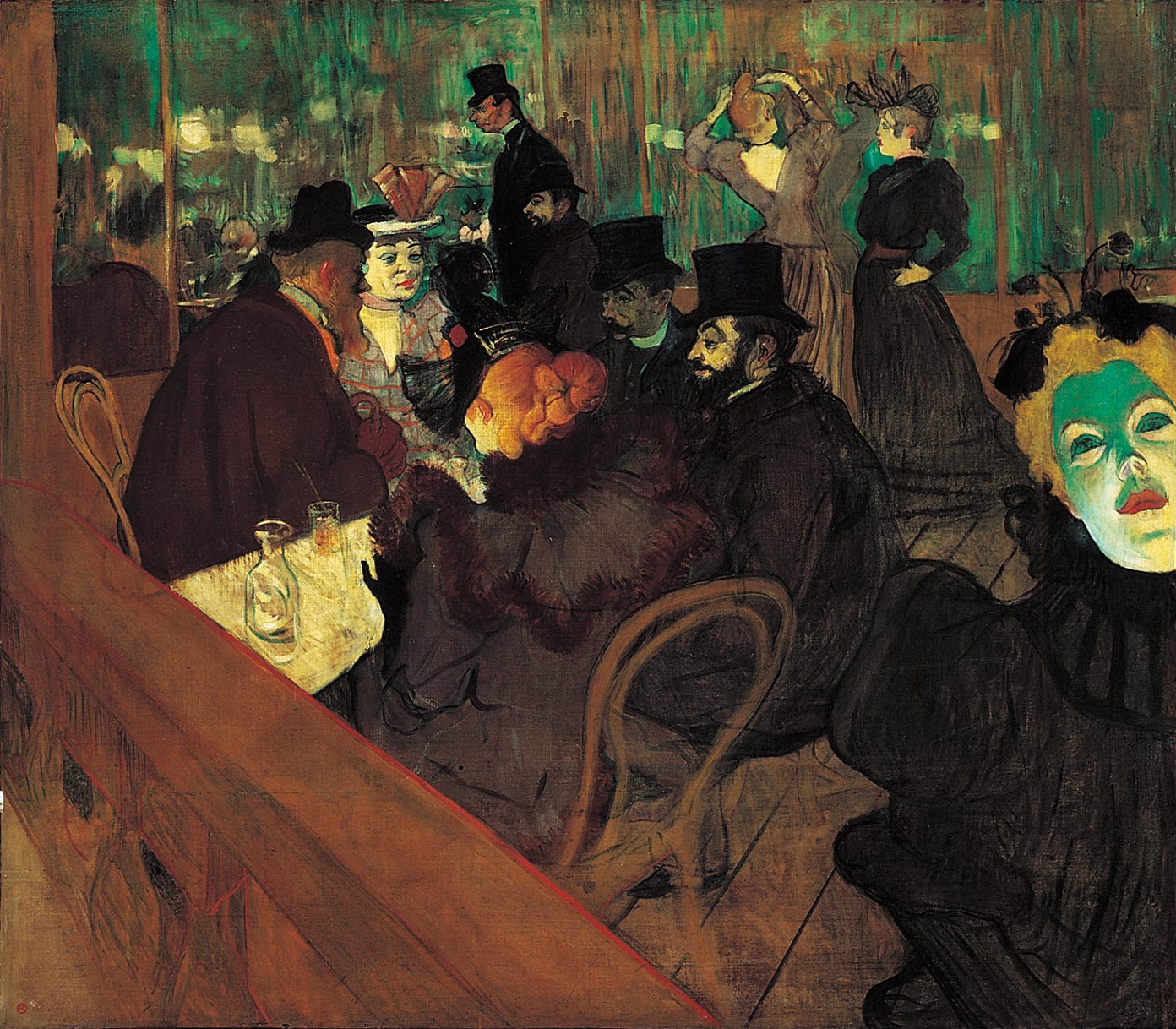
Toulouse-Lautrec’s legs were deformed, and as a result he was very short. He shows himself in the background of the scene next to a tall companion, emphasizing his difference. He is not the focal point of the picture though; that is the woman at the right, whose face, garish in the green light, is cropped off by the picture frame. The rest of the figures are mottled and posed so you can’t see them full on; the view is from behind a balcony which is itself cut off, giving the room an off-kilter sense of cramped wrongness.
Toulouse-Lautrec’s disability can be seen as a metaphor for the entire scene. Alternately, the air of decadence—the sex workers, the drinking, the intimations of lesbianism, the whole disreputable milieu—is one in which Toulouse-Lautrec’s body fits, or is accepted, as one sign of difference or otherness. The picture is “modern,” realistic, powerful, because it rejects an older notion of ordered composition, ordered sexuality, ordered bodies.
Hokusai is certainly a source for Toulouse-Lautrec’s dramatic cropping and for his idiosyncratic organization of space. I don’t think Hokusai uses disability as a modernist aesthetic in the same way, though. The image of the disfigured man isn’t defiantly imperfect, or even matter-of-fact in a realist imperfection.
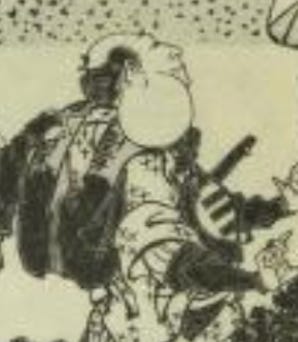
The laughing bystanders suggest a sharp line between abled and disabled—and of course the sweeping landscape here is very distant (in various senses) from the sweaty interior of the Moulin Rouge. Hokusai does not show us a tumult of wrongness and difference hustled together in a valediction of (various meanings of) queerness. Disability in this view is simply one blot on the face of a great vista.
But of course it isn’t just one blot. It’s two. The mountain itself, with its odd hump, echoes and mirrors the man’s growth; disability is literally part of the landscape. And while most of the men in the foreground laugh and gesture at the human disability, there is one man, his back to us, his posture relaxed, who looks contemplatively at the mountain with its hump, appreciating nature’s perfect imperfection. Perhaps he is struck (as the viewer of the print is) by the way that even the mountain’s disfigurement is echoed in the humans who pass before it.
Throughout his art, Hokusai portrays Fuji as an unchanging symbol of immortality—a steady, silent presence in the background of humanity’s bustle and swirl. The Hoeizan images, though, and perhaps especially this second one, suggest that even the mountain itself can alter, its perfection worn down, or blown apart, by time and nature. Rather than a defiant celebration of wrongness, a la Toulouse-Lautrec, the image suggests that wrongness and rightness are part of the same landscape and the same sweeping, energetic, faultlessly lumpy line. If Fuji is disabled, then disability itself is a kind of perfection—a mountain that overlooks us all.
The disfigured man has taken off his hat and is gazing at the imperfection in Mt. Fuji with a seemingly happy look on his face. He apparently sees himself reflected there.
thank you for this , Noah. deeply speaking to me on so many levels ❤️💐