

As some of you may know, I am not only a middlingly-successful political pundit and arts critic; I am also an even less successful poet! I do not write much about my poetry or my process here because—well, no one cares about poetry, and even people who care about poetry don’t care about my poetry.
But! A professor friend asked me to talk to their class about my verse—and especially about my interest in algorithmic poetry and uncreative writing. To prepare I was going to write out my thoughts, and I figured why not share them in the newsletter where all my thoughts go?
So, this is going to be a brief discussion of what algorithmic poetry is, how to create it if (like me) you have no programming knowledge or aptitude, and why you might want to bother creating it. Feel free to skip and/or enjoy, depending on your level of interest in weird soulless art!
---
I’m going to start by reading a poem made up of the first words from the last few text messages between the friend who put me up to this and myself.
This Is Awesome
I sent
I saw
question while
I’ve had a
it really
oh Jesus
ah well
so what
instructions for
aha!
Now, you may read that and say, “What?.” or “Aha!” or, “Why on earth would anyone write or read such a thing?” These are all valid reactions, and I hope to address some of them.
But what I want to point out first is that this is an example of very, very low-tech generative art, or low tech algorithmic art. I didn’t write it by letting divine inspiration flow through me and reveal my deepest truest self. Instead, I set up an algorithm—the algorithm being, “take a couple of words from the beginning of each text between you and your friend”—and then I just listed what I found. Revealing that my truest deepest self is a cut apart text message chain.
Constraints for everyone
A lot of people think this is a weird way to do poetry because it’s not personal, doesn’t use flowery language, doesn’t rhyme, doesn’t attempt to make sense. But I think there are a lot of ways in which this is very much in the poetry tradition. That’s because much of the poetic tradition relies on algorithms, or constraints.
By constraints I mean that poetry is often written by setting up rules (algorithms) or limitations. For instance, the poet Robert Herrick, wrote this poem in the 1600s.
Upon His Departure Hence
Thus I
Pass by,
And die :
As one
Unknown
And gone :
I’m made
A shade,
And laid
I’ th’ grave :
There have
My cave,
Where tell
I dwell.
Farewell.
The poem has only two syllables to each line, and every three lines rhyme. “Thus I/ Pass By/And die.” That’s a lot of constraints; he’s showing off.
Here’s another example by twentieth century poet Richard Wright.
With a twitching nose
A dog reads a telegram
On a wet tree trunk.
Wright was using the Japanese form called the haiku; in the first line, there are five syllables, in the second seven, in the third five. Again, the fun is to try to fit your thoughts into a rigid container—or to let the demands of the constraint push you towards finding something to say.
Starting in the early twentieth century, artists and poets started to experiment with less traditional constraints which drew more attention to themselves, or pushed poems towards more absurdity or certain kinds of randomness. The movement was called oulipo. One common oulipo technique was to write poems excluding certain letters, or only allowing the use of certain letters. An amazing example is Christian Bok’s 2001 book Eunoia, which consists of five chapters, in each of which he uses only one vowel. Here’s a bit from Chapter I.
I bid girls bring stiff drinks—gin fizz which I might sip whilst finishing this rich dish, nibbling its tidbits: ribs with wings in chili, figs with kiwis in icing.
Bok used a whole bunch of other constraints too; he wouldn’t use “y” because he felt that was cheating, and in each chapter he tried to use every single possible word that included only the vowel in question and to use each of those words only once (though he admits he missed some.)
Constraining yourself into uncreativity
The point of constraints, or of an algorithm, is to restrict the possible choices the author can make. The tighter the constraints, the less forgiving the algorithm, the fewer choices the writer has to make. Eventually, if you’re lucky, you reach a point where the only choice is what constraint you’re going to put yourself under.
As an example, a poet named Rory Macbeth decided he would write a poem composed of every word in the Bible in alphabetical order. There are eight pages which read just
be be be be be be be be be be be be be be be be be be be be be be be be be be be be be be be be be be be be be be be be be be be be be be be be be be be be be be be be be be be be be be be be be be be be be be be be be be be be be be be be be be be be be be be be be be be be be be be be be be be be be be be be be be be be be be be be be be be be be be be be
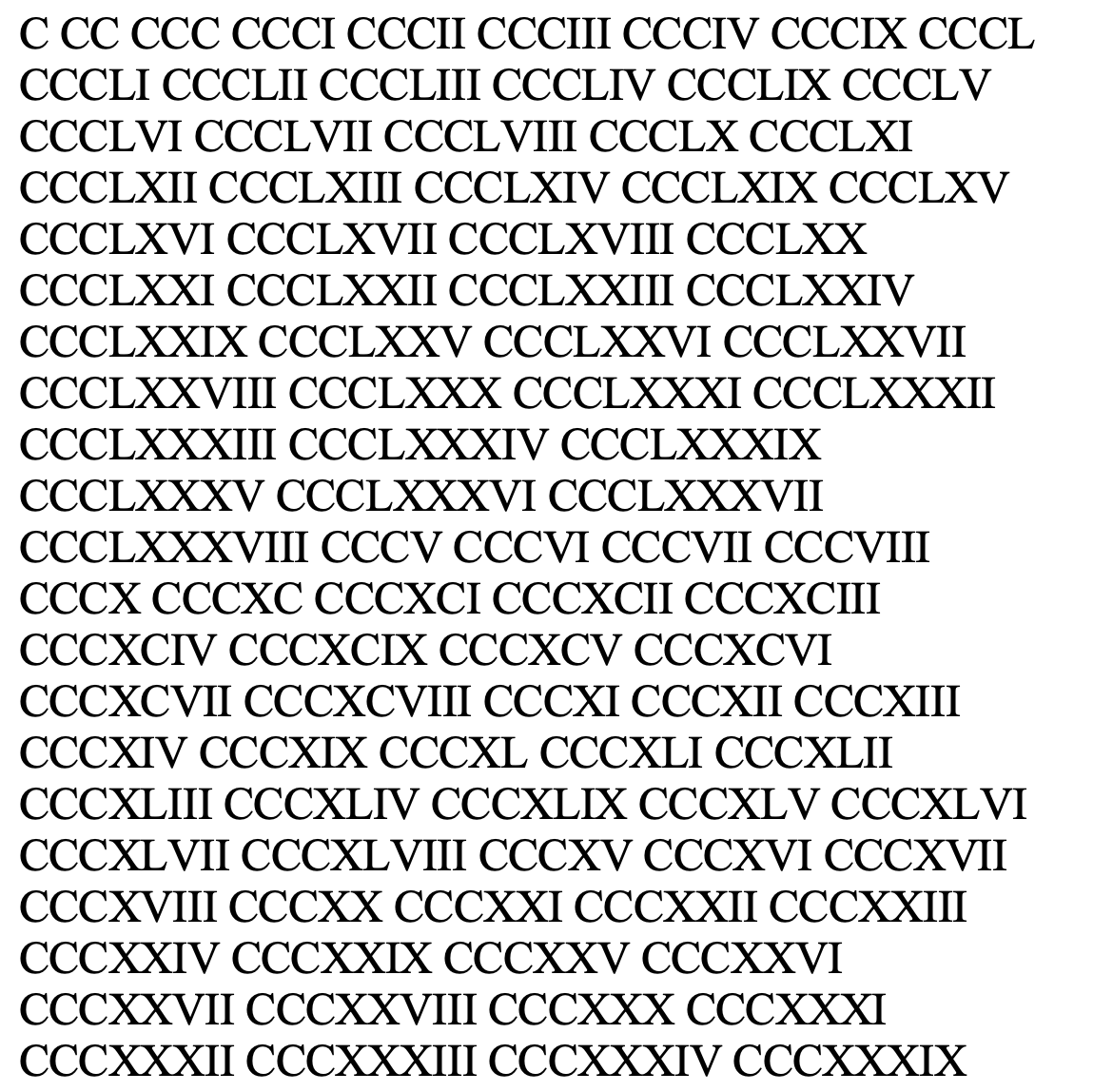
Claude Casky’s “The First Thousand Numbers Classified in Alphabetical Order” is exactly what it sounds like; it’s a list of the numbers from 1 to 1000 in alphabetical order , starting with, “Eight, eight-hundred, eight hundred and eight” and ending with “two-hundred and two.” (That inspired me to create a poem listing all the Roman numerals in alphabetical order from I to M.)
Poet Craig Dworkin calls this kind of writing “uncreative writing” because the constraint squeezes out all creativity. Or you could also think of it as writing in which all the creativity comes in figuring out the constraint or in setting the prompt; once that’s done and your algorithm is “alphabetize every word in the Bible” the rest is just listing a bunch of be’s.
These poems could also be seen as conceptual art; the pleasure is in the idea rather than the execution. You don’t have to read every number from 1 to 1000 in alphabetical order to get the joke. (Though I kind of enjoyed doing so.) In that sense, you can really just make up constraints and call that the poem—which means you can call for impossible constraints if you want. Here is a poem I wrote made of instructions for eleven more or less impossible exercises in uncreative writing. (It first appeared in my book Meaning Is Embarrassing from Ranger Press.)
Instructions for Eleven Poems
1. Take your favorite sonnet. Remove the third line.
2. Find the book nearest you. Write down the first word on each page. Start a new line with each capitalized word.
3. Take the Mary Oliver poem “The Swan.” Remove every word that does not include a letter in your first name.
4. Buy a physical copy of the second book on the New York Times nonfiction bestseller list. Open the book to page 84. Take a quarter cup of flour and shake it evenly over the page. Write down the words that are still visible.
If no words are visible, shake off the flour and try again until your poem has at least three words. If the book does not have 84 pages, wait a week and try again with a different book.
5. Find the last spam email sent to you. Arrange the words in the email in reverse alphabetical order.
6. Save a document called “3:13 PM.” At 3:13 PM, paste whatever text you last copied into your document. Do the same at the same time each day for a month.
You can choose to copy text deliberately to paste at the appointed time. Or you can just paste whatever you happened to copy. The only rule is that you must paste the text every day at the same time. No other work on the poem is allowed.
7. Take a poem you dislike. Write it backwards; that is, the last word is the first word, the second to last word is the second word, the first word is the last word. Title it “Bad Poem.”
8. Keep a record of the wordcount of every web page you visit over a 48-hour period. Write out the name of the page and then write out the number next to it.
9. Go to a library. Write down the call number for every book of poetry. Exclude books by John Ashbery.
10. Retype these instructions. Do not correct any errors.
11. Write down the last line of each of the 11 poems you wrote following these instructions.
And here’s another example I wrote just recently. I went to Genius.com, which is a site that archives song lyrics for a huge range of popular songs. I put the phrase “We’re all” into the search engine, and then arranged the first 100 results I found (more or less) into a poem.
Here’s the first few lines
What Are We All?
We’re all sensitive people with so much to give
We’re all in the mood for a melody.
We’re all making love.
We’re all stars and we see that.
We’re all chemicals, vitamins, and minerals.
We’re all impressed by this.
We’re all in line for the throne.
We’re all back together and stuff.
We’re all the things that we do for fun.
We’re all chasin’ after all the same.
We’re all livin’ in the same shit sandwich.
—
Lyrics sourced from genius.com, artists in order are:
Marvin Gay
Billy Joel
BLACKPINK
High School Musical
Lupe Fiasco
Message Man
Lorde
Weezer
Lorde
Frank Ocean
There you go. We’re all writing poetry! Or compiling poetry anyway.
Why would you do this?
Again, some of you may be wondering, why would anyone want to do this? What’s the point of creativity without creativity? Why alphabetize the Bible? What’s wrong with you?
There are a few reasons to do this (or a few things wrong with me, depending on how you look at it.)
First of all, constraint-based poetry is fun. It’s a lot like a distraction game such as tetris, except when you’re done you have a collection of more or less entertaining word things rather than a score. Poetry doesn’t have to be a huge statement or a deep confession of inner truth; it can just be an enjoyable way to challenge yourself to make sense and/or nonsense out of the words and not words around you.
Second, constraints can push you to write more interesting, more adventurous, more satisfying poetry. Poetry is a form of language which is meant to be heightened, self-conscious, or special. Constraints—rhyme, oulipo, collaborating with genius.com—is a way to get yourself into a space where you’re paying attention to language in new or odd ways. You’re counting syllables, or looking for words with only the letter e, or trying to alphabetize one, two, three. That’s poetry.
Finally, I think algorithmic and uncreative poetry feels meaningful right now—especially perhaps if you’re using genius.com, or taking lines from your text messages, or from your spam folder. With the internet and now with AI, we’re all inundated with text all day every day, some of it interesting, some of it weird, some of it meant to confuse us or insult us or scam us. A lot of my experiments with algorithms and constraints is intended to talk back to what feels like an onslaught of voices, or to talk with them, or near them. I find that meaningful. I hope after reading this some of you will as well.
Try it!
As I said, I just recently stumbled on the idea of using Genius.com to write poetry. The process is straightforward.
1. Come up with a favorite lyric.
2. Type a portion of that lyric into Genius.com’s search.
3. List the results, one lyric per line.
So, for example, I could start with the Jimi Hendrix lyric “Excuse me while I kiss the sky.” I’m going to try just the phrase, “Excuse me while” and see if that works.
Here’s a poem with the first ten results (more or less.)
You’re Excused
Excuse me while I kiss the sky.
Excuse me while I kill myself.
Excuse me while I break my own heart tonight.
Excuse me while I drink myself to death.
Excuse me while I find myself
Excuse me while I cry.
Excuse me while I count all these hundreds.
Excuse me while I bite my tongue.
Excuse me while I feel my nuts.
Excuse me while I sympathize.
Jimi Hendrix
Sentenced
Whiskeytown
Spent
Sentenced
Zeph
Kevin Abstract
Lil Uzi Vert
Reneé Rapp and Megan Thee Stallion
Eminem
Mike Shinoda
I guess you wouldn’t have to keep track of the original artists, but I’m a little obsessive, so I do.
Note that constraints don’t have to be a suicide pact. If you search a phrase and there aren’t enough examples to make a poem, just search something else, or shorten what you’re searching for. If there’s a lyric you don’t like because it seems boring or irritating, you can just skip over it.
Or you can decide you must skip nothing and write down everything in exact order. It’s up to you. One fo the things you discover as you work with uncreative writing is that you are actually left with a lot of creative decisions even when it seems like you should have eliminated them all. Words and language are tricky; they keep demanding that you think with them, or near them. That’s part of the meaning of poetry too.
If you’ve made it this far…
…and want more poetry from me, you can find links to my books and chapbooks and poems and lots more here.
My most recent publication is from sider0xylon press; it’s a chapbook called “Summaries Are Positive On Some Level,” with text collaged from a bunch of debased bestsellers, including J.D. Vance’s Hillbilly Elegy. Hope some of your are inspired to check it out!
Truly a delight to read! I have loved writing haiku since discovering the form in (I think) the 4th grade. I especially like writing them for the cats 😸 I also think making memes is kind of like 21st-century visual haiku
Lovely!
And
Sent to my mom, as we were just talking about constraints upon art, and she is also a lover of poetry