

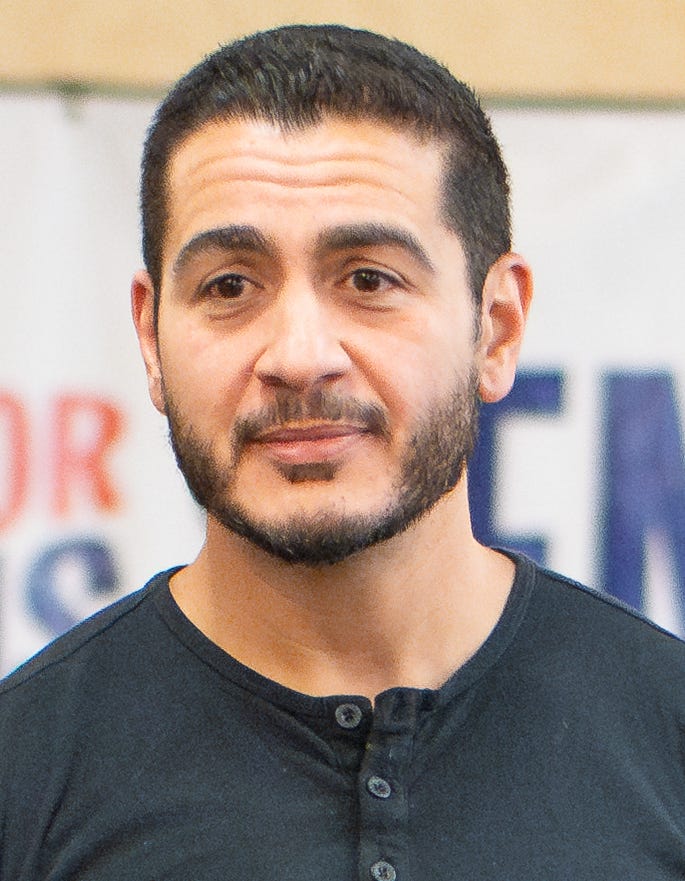
—
Everything Is Horrible is entirely funded by readers. If you value my writing, please consider becoming a paid subscriber. It’s $50/year, $5/month.
—
Last November, everyone was convinced that Democratic candidate Mikie Sherrill was a weak candidate for governor of New Jersey. In a blue wave year, she was struggling in the polls against a drab Republican opponent. One poll just days before the election had her up by only 2. Some commenters said that she was losing because she was a boring spineless centrist; others, like NYT columnist Jamelle Bouie, argued that her campaign was simply “unfocused, half-hearted.”
Then New Jersey actually held its election, and Sherrill won by 13 points, 7 points better than Harris did in the state in 2024. “In retrospect,” I wrote, “Sherrill did not run a bad campaign. She seems to have run a solid campaign—maybe even an exceptional campaign.”
Conventional wisdom about Sherrill was completely wrong. People’s estimation of her quality as a candidate was based on inaccurate polling and inaccurate assumptions. Predicting the future based on spotty data is, it turns out, quite difficult. Analysts should be careful about doing that.
And yet, in the Michigan Senate race, analysts are not being careful. Instead, many are making similar assumptions right now about the quality and probable fate of Michigan Democratic Senate nominee Abdul El-Sayed. We are being told he will lose; we are being told that progressives have put the seat in peril by selecting an extreme candidate/a candidate who is not Zionist/a candidate who is a Muslim.
And it’s certainly possible El-Sayed will lose. But also it’s very possible he won’t. The panic is built on even less evidence than the worries about Sherrill. It’s worth looking at what we know, at what we don’t—and at the ways in which getting out over our skies can be harmful to our coalition.
We don’t know how El-Sayed would do in a GE right now
A number of pundits have come out with very strong claims about El-Sayed’s likely weakness in a general election. For example, poll analyst Lakshya Jain wrote this week that “El-Sayed would have to be one of the worst Democratic candidates in the whole country to lose Michigan” in the blue wave midterms of 2026.
This sounds like it is providing you with information. But is it? You could just as easily say, “If El-Sayed wins Michigan by 20 he’d be one of the best Democratic candidates in the whole country.” You could have said in October 2025, “Mikie Sherrill would have to be one of the worst Democratic candidates in the country to lose New Jersey.” For that matter, you could say, “if we had some bacon we could have bacon and eggs, if we had some eggs.” You can write any hot take you’d like about the future you’ve made up; it doesn’t actually tell you diddly squat because it’s based on nothing.
As analyst G. Elliot Morris notes, Lakshya’s post “is a take about an unrealized future election outcome using cherry-picked data.” It also ignores the fact that Haley Stevens wasn’t doing much better than El-Sayed in pre-primary general election polls. From the beginning of the cycle, Michigan GE numbers have just been a lot closer than it seems like they should be given Michigan’s general partisan make-up (Trump won by 1.5 in 2024) and a generic ballot that has Democrats up by 6.
Polling in Senate races in Ohio, Texas, and Alaska currently favors Democrats; if they are ahead in those red states, they should be romping in purple Michigan. But they haven’t been. No one is sure why. But it’s a big assumption to blame El-Sayed when Stevens’ numbers were also weak.
It’s also a big assumption to blame El-Sayed when we don’t have a ton of data about how he’s doing right now. Michigan Senate primary was held only a couple of weeks ago. General election polling before a primary is very dicey, and there hasn’t been a ton of people in the field since the election was held.
In fact, as of right now, there have been exactly three polls conducted since the primary ended. An independent Fox News poll had Republican asshole election denier Mike Rogers up by 4 points. A GBAO Democratic sponsored poll had El-Sayed up by 6—the biggest Democratic lead in the state the entire cycle. And a Republican sponsored TIPP poll had El-Sayed up by 3. Currently the Fiftyplusone poll aggregator has El-Sayed ahead by 1—which means based on polls the election is essentially a toss-up.
Even saying it’s a toss-up with so few polls, though, tells you less than you might think. It’s possible that the election will be very close—within one point. It’s also possible that, for whatever reason, Mike Rogers really is bucking the blue wave and cruises to a four-point victory. And it’s also possible that El-Sayed does what you’d expect in a blue wave year in a purple state and wins by six without much fuss.
It’s even possible that El-Sayed does what Mikie Sherrill did, overshoots polls, and wins by 10. There was a huge miss in the Michigan primary, which had El-Sayed up double digits on Haley Stevens; in the event he only eked out a narrow win. This kind of miss is quite common in primaries, according to G. Elliott Morris, since pollsters cannot use partisanship to help calibrate their findings and voters, untethered from partisanship, often change their minds at the last minute. General election polls are usually more accurate, but “usually” isn’t “always,” as the miss in Mikie Sherrill’s race showed.
Your bad electability takes can harm the coalition
Pundits being wrong just means it’s a day ending in “day.” So some analysts are getting out ahead of the data. Eventually we’ll find out if they’re right or wrong (as we did with Sherrill) and then this whole conversation will be irrelevant. Why worry about it?
I think there are a couple reasons to be concerned when high profile commenters spew nonsense about electability.
First, I just want to be clear that the Sherrill comparison is useful in part because the discussion of El-Sayed is so much more egregious. Sherrill really was a pure polling miss; polls aren’t perfect, but they’re the best data we have, and the polling in the Sherrill election was just off—probably in part because of too many bad GOP aligned pollsters. The commentary on the election was off-base in various ways: Sherrill was not a bad candidate because she was too centrist, for example. But the commentary wasn’t obviously in bad faith. People were trying to make sense of the data they had.
The El-Sayed discussion is different. We really have little to no data that El-Sayed is a bad candidate. That may change in the coming months, but right now the panic about his candidacy is simply not driven by any data we have. It is driven by other things.
One of those other things is obviously faction. Many in the Democratic party disagree with El-Sayed’s progressive politics, and especially with his view that the US should end military aid to Israel while it is committing a horrific genocide. Pro-Israel groups like AIPAC poured millions into the Senate race in Michigan, outspending El-Sayed 9 to 1. His victory is another indication that Democratic primary voters have swung strongly against Israel’s policies.
But while Democratic primary voters are opposed to the current Zionist consensus, Democratic elites are another matter. Some centrists are committed Zionists. Others simply hate to see the partisan polarization of a bipartisan issue—an issue which in theory allowed Demoratic candidates to appeal to Republican voters and Republican donors. Some centrists insist that centrists perform better electorally, though that shibboleth has been largely debunked.
And some El-Sayed nay-sayers I’m afraid are actuated by bigotry. Studies have found that non white male candidates, such as Black women, are often perceived as less electable despite the fact that they suffer no real electoral penalty. In other words, voters tend to believe that other people are bigoted and that therefore non white male candidates will lose or are weak electorally.
Displacing animus onto other people also of course becomes a way to express one’s own animus. “I don’t have anything against Muslims—El-Sayed is just, for some reason, a bad candidate. It is the electorate which recognizes his radicalism, which of course isn’t necessarily related to his religion or ethnicity.”
In short, electability concerns, when used, with little evidence, to smear non white male candidates, often function as dogwhistles. That’s perhaps especially the case for a Muslim Arab-American anti-Zionist candidates right now, whose policies, supposed radicalism, and ethnic and religious identities are all conflated with invidious stereotypes.
Democrats are a party of multi-racial democracy or they are nothing. The party depends on a diverse coalition, each committed to fighting the fascism that threatens us all. In that context, reckless use of dogwhistles can be incredibly destructive, eroding the trust and solidarity which is core to party unity and victory. Even if hot takes about El-Sayed’s electability don’t affect the eletion, they can alienate core constituencies, making it more difficult to make progress long term by making people feel they have no stake in the Democratic party or in American democracy.
“El-Sayed can’t win” as an article of faith, without much evidence, is going to be interpreted by many people, with good reason, to mean, “Muslims and Arab-Americans are not really American.” That is a message that people of good faith should not be blasting out to Muslims, to Arab-Americans, or to anyone else.
Your bad electability takes can make it harder to fight fascism
It’s also worth reminding ourselves one more time where the politics of electability have brought us in the present moment. In 2020, Democrats were desperate to find someone who was electable and could defeat Donald Trump. Non white non male candidates like Elizabeth Warren and Kamala Harris; so did non centrist Bernie Sanders.
Ultimately, though, voters opted for old party stalwart Joe Biden, associated with Obama’s winning presidency. Biden seemed knowledgeable, safe, unlikely to offend, ready to restore normality.
And Biden did win in 2020. He ran a steady ship, righted the economy, and negotiated a surprisingly progressive suite of policies through Congress, often with bipartisan support.
But safe Biden did not want to prosecute his predecessor. He chose safe centrist old guy Merrick Garland for Attorney General, and Garland proceeded to drag his feet on holding Trump accountable, no doubt in line with Biden’s preferences. Biden’s long record as a party stalwart also meant that he was a throwback Zionist in terms of Israel policy, making him just about the worst possible person to hold office when Hamas launched a horrific attack on Israel and Israel responded with an even more horrific genocide.
The things that made Biden seem electable in 2020—old familiar centrist white guy—also made him unable to crush fascism, allowing Trump to escape accountability, complete his coup, and create a competitive authoritarian regime. In retrospect, someone with less taste for stability and normality—Warren, Sanders, Castro, or even Buttigieg or Harris—seems like they would have been a better choice.
Hindsight is always 20/20, of course. But that’s all the more reason not to claim to have some paranormal power to identify the safest Democratic candidate based on vibes and two inconsistent polls. We can’t control the future or always know the best path forward. What we can do is stand in solidarity with each other—not least with people and groups who have faced a lot of bigotry and prejudice even within our own coalition.
El-Sayed may win; he may lose. We can’t know which yet. But there is plenty of reason to believe it is possible that Michigan, a purple state, will choose a Muslim Arab-American to represent them as a rebuke to a wildly genocidal and Islamophobic president. That’s not a sign that Democratic primary voters are foolish or insufficiently poll-obsessed, especially in the absence of actual polls. On the contrary, it is hopeful; it is inspiring. As people of good will who want to defeat fascism, we should treat it as such.
Begging for a Democratic party with some confidence in its own voters and not one run by a consultant class and electeds scared of its own shadow. The Democratic voters of a state elected a more liberal or non-white man candidate for an important seat? Fuckin' a they did and we're gonna trust they made the right choice and help them win. Jfc this really shouldn't be difficult. This is like Poli Sci 201 level shit. Which funny enough is easy for them to understand when it's a centrist candidate they want liberals to turn out for...
I saw "GE" and for a minute there I thought you were implying General Electric was backing him...