

There is a 40% off sale today; $30/yr. If you value my writing, please consider becoming a subscriber so I can continue to scribble.
—
Eric Kripke’s superhero series The Boys started as a metaphor for American fascism during Trump’s first term. And now, in the middle of its fifth and final season, it, like our country, has embraced its bleak and final form.
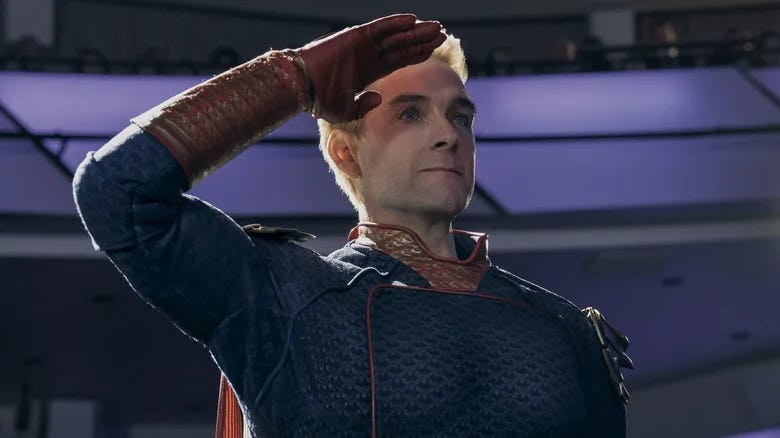
Homelander (Antony Starr), an all-powerful messianic narcissist, has seized absolute power. He’s head of the uber-corporation Vought and also de facto ruler of the United States; he’s destroyed all opposition and sidelined anyone who would restrain him. Enemies of the state—from active dissidents to people who post irreverent social media jokes—are rounded up and thrown into concentration camps where they face extrajudicial execution. Universities, churches and media have all bent the knee to the regime in an orgy of patriotism, Christofascism, capitalist corruption, and power-lust.
It’s impossible to watch the show without wincing at its almost uncanny relevance; in the fourth episode, released yesterday, Homelander declared himself to be the messiah. That was about ten days after Trump posted a picture of himself as Jesus.
The ability to capture the zeitgeist is most impressive, though, in the way that the series imagines a dystopia which is not immediately or obviously less awful than the dystopia we are actually living through. In accurately reflecting how bad things can get—and how bad things are—the show manages to offer insights into where we’ve gone wrong, where we’ve maybe gone right, and where we can go even wronger if we really try.
Homelander and Trump: equally evil
Obviously, a big part of the reason that The Boys accurately represents our current nightmare is that the creators live in our current nightmare; they are reporting on what they see.
The thing is, though, that most dystopian narratives are not in fact willing to honestly or unflinchingly reflect on or represent the worst aspects of life under American fascism. For example, as I discussed recently, TV shows like Severance and movies like Superman present fascism as a kind of conspiracy, which can be defeated by exposing its mechanisms. When brave journalists show the people that Lex Luthor has a nefarious plot, people reject the plot en masse, and justice is served.
The Boys’ creators, though, have looked around them, and they know this is not how fascism works. Fascism doesn’t triumph because it is secret. It triumphs because people like fascism and find it an exciting and pleasurable way to shore up their status in the hierarchy and inflict pain on others. If they are fooled, it is often because they want to be, or because they simply don’t care that (for example) Trump was held liable for sexual abuse.
In that vein, in a past season, Homelander murders a protestor on live television, and his fans erupt in cheers, because they identify with his power and enjoy the rush of (supposedly) righteous violence. In season 5, the leader of the resistance, Starlighter/Annie (Erin Moriarty) manages to leak a tape showing Homelander callously leaving a plane full of people to die horribly. Vought’s PR flaks immediately declares the video a deep fake; it barely affects Homelander’s popularity (though it does lead him to make some strategic miscalculations.)
It’s also common for pop culture dystopias to treat oppression as universal—totalitarian governments on the screen are bizarrely less racist and/or sexist than the totalitarian government we have. The Handmaid’s Tale series, for example, portrays a patriarchal, misogynist Christofascist government which somehow does not see color. The recent Edgar Wright Running Man reboot features a vicious capitalist dystopia which is neither racist, sexist, nor homophobic.
In contrast, the authoritarian violence in The Boys is justified and advanced by hate, which is then directed at marginalized people. Homelander is (like Trump) not a systematic thinker with a worked out Hitlerian program. But he loathes what he sees as weakness and difference, and that makes him a natural ally of more rigorous fascists and of other misogynists, assholes, and bullies.
In one incident in an earlier season, Homelander physically assaulted a blind hero (a Daredevil analog) because he was disgusted at the idea of a disabled person being in the Seven. disabled hero because he hates disabled. Analagously, in the first season, one of the members of the Seven, the Deep (Chace Crawford), sexually assaults Starlighter when she first joins the team. Vought’s podcasts and publicity trumpet manosphere masculinity and attack trans people; in the spin off series, Gen V, the regime smears a genderfluid superhero by saying they assaulted a woman in a bathroom. For the people running the fascist regime, bigotry is, unsurprisingly, varied, pervasive, and routine.
The Boys also understands that prejudice doesn’t preclude tokenism. One of the most affecting character arcs in the series involves the superfast superhero A-Train (Jessie T. Usher), who is explicitly brought onto the Seven to show that the team is colorblind. He understands why he’s been brought on, and feels it’s a reasonable price for fame and power. He’s a callous, cowardly jerk who likes power and the spotlight, and ends up murdering multiple people out of casual incompetence and/or a desire to cover his ass.
But, again, the Seven are racist. Eventually the micro-aggressions (and not so micro-aggressions when he’s insulted by an actual Nazi) alienate A-Train from the team and push him to help out Homelander’s enemies. Little by little, and with the help of his family, he begins to see the racism he faces not just as a personal insult, but as part of a hateful, unjust system, and to see heroism as not just a way to play for the cameras, but as an actual possibility for himself.
The end of his story, in the first episode of season five, is one of the few actually convincing and moving redemption arcs on television—a careful, step-by-step portrayal of how a weak and evil man finds a path to solidarity and antifascist resistance. And, again, it’s a narrative that’s only possible because The Boys understands that any American dystopia is going to be racist.
Homelander more evil
A-Train’s courageous defiance of Homelander is especially gallant because resistance in The Boys is rare. Homelander and his superhero allies have the kind of power that Stephen Miller can only dream of; a couple of superheroes can do a lot more damage than a whole cityful of ICE agents. The fact that superheroes are celebrities in addition to their other abilities has allowed for more effective propaganda, too—it’s as if every leading figure in Hollywood turned into J.K. Rowling.
With greater approval numbers and more raw force, Homelander doesn’t face anything like the unified resistance in Minneapolis or Chicago. There are no mass No Kings protests; there are no spontaneous, effective boycotts like the one which saved Jimmie Kimmel. There also appears to be no opposition party and no opposition from courts. Without broad popular opposition and without institutional levers, resistance is essentially limited to guerrilla cells, which use violence because they have few other options.
The narrative incentives here are obvious enough. The Boys is a superhero show, so you want to watch superhero action. People are not tuning in to watch a bunch of people cancelling their Disney+ subscriptions or following ICE agents around Minneapolis.
The alternate universe in which a Trump analog has truly broad-based public support and/or has access to overwhelming force is clarifying though. First it underlines just how limited Trump’s repressive resources actually are; even with his bloated ICE budgets and even with present day surveillance tech, his reach remains quite limited. And second, it shows the importance of those nose-diving poll numbers.
Widespread resistance makes it much harder for Trump to rig elections, to terrorize his enemies, to make people believe his bullshit. He wants to be Homelander, but he is not there yet—and there is reason to hope he never will be. The Boys shows us that things could be worse, and in doing so highlights the tactics and strategies that—not uniformly, not enough, but in important ways—have limited Trump’s power.
Trump more evil
The Boys shows a bigoted fascist totalitarian state with a wide base of support, unlimited resources for violence, and a desperate and largely ineffectual resistance. And yet, there are some ways in which that evil, sweeping, apparently all-powerful regime is still not as bad as the one we’ve managed to install in power.
The main issue here is foreign policy. The Boys focuses almost entirely on domestic affairs. But many of the worst depredations of the Trump administration have been overseas. The cuts to USAID are believed to have killed more than 750,000 people , including more than 500,000 children. Total number dead is expected to reach 14 million, by 2030—making this the worst genocide committed by a single US president in history by a significant margin.
There is also no analogy in The Boys for the Iran war, with the US slaughter of schoolgirls, or for US withdrawal of aid from Ukraine, or of our complicity in Israel’s ongoing genocide in Gaza. The US is a global power, and in many ways its leaders’ capacity to sow misery and violence is greatest beyond its own borders, where democratic checks are lessened and politicians don’t have to worry about the possible downsides of harming their own constituents.
The Boys in an earlier season dabbled a bit with the idea of Homelander interfering in international affairs. But mostly it stays within American borders. That’s not unreasonable; you can’t do everything, and there’s certainly enough misery in the US itself to power five season and more of antifascist television.
It is telling, though, that the USAID atrocity—which is, again, unquestionably the single worst thing the Trump administration has done—isn’t addressed on The Boys for the same reason it isn’t a major story every day in the news. Americans care about America; the suffering of children far away doesn’t concentrate the minds of US viewers.
This circumscribed solidarity isn’t fascist in itself. It is, however, part of the soil in which fascism can grow. Homelander thrives when people only care about the homeland; Trump thrives when only Americans (narrowly defined) are seen as worthy of rights and freedom. As The Boys insists, with A-Train and throughout the series, the only way to fight the power is to realize that your struggle is your neighbor’s struggle and to understand that your liberty depends on your neighbor being free. When we forget that, or ignore it, we are all diminished—not least those who die offscreen because we don’t know how to fit them into our stories.
Another interesting comparison point: Soldier Boy is Homelander's father, and Soldier Boy is disgusted by his own son's weakness and neediness. Narcissists, like Trump and Homelander, are desperate for approval and attention. It's been said that Trump's father was a tyrant and I'm certain Donald got the brunt of his authoritarian, mobster ways.
What's interesting about "The Boys" is the writers don't make Homelander one-dimensional. He's a complicated, fucked up guy who wants to be adored,--even worshipped as a god--but can brook no dissent, even by his own son. Loyalty in Trump/Homelander world is paramount, but loyalty and love are not the same. You can almost--almost--feel sorry for Homelander. I have no such empathy for Donald.
I love this show. It's really smart. Antony Starr is brilliant and I hope to see a lot more of him when this series is over.
The biggest difference between them is notable: Homelander faces next to no effectve opposition, super-powered or otherwise, whereas Trump has seen effective push-back for all his actions nearly since he began his second term, in the shadows at first but increasingly overt. Which goes to show that it is far easier to run a fascist dictatorship (at least in North America) in fiction rather than fact.